As volatility returns to the S&P 500 index, some investors may consider safer alternatives for their portfolios. Wall Street analysts agree... ͏ ͏ ͏ ͏ ͏ ͏ ͏ ͏ ͏ ͏ ͏ ͏ ͏ ͏ ͏ ͏ ͏ ͏ ͏ ͏ ͏ ͏ ͏ ͏ ͏ ͏ ͏ ͏ ͏ ͏ ͏ ͏ ͏ ͏ ͏ ͏ ͏ ͏ ͏ ͏ ͏ ͏ ͏ ͏ ͏ ͏ ͏ ͏ ͏ ͏ ͏ ͏ ͏ ͏ ͏ ͏ ͏ ͏ ͏ ͏ ͏ ͏ ͏ ͏ ͏ ͏ ͏ ͏ ͏ ͏ ͏ ͏ ͏ ͏ ͏ ͏ ͏ ͏ ͏ ͏ ͏ ͏ ͏ ͏ ͏ ͏ ͏ ͏ ͏ ͏ ͏ ͏ ͏ ͏ ͏ ͏ ͏ ͏ ͏ ͏ |
| | Written by Gabriel Osorio-Mazilli 
Regimes are changing in the market, and this could mean a few things, but today, it means that volatility is back. Whenever these shifts come, specifically to the S&P 500 index, investors tend to decrease their exposure to riskier stocks to look for more defensive names in the market to cushion some of the risks that come with these volatility spikes. This is where names in the consumer staples sector usually come into play. These stable and predictable business models and product lines usually carry low betas, compressing the volatility that comes with them even with a broader market selloff like the one experienced in recent weeks. Therefore, they are more attractive buy targets for investors to consider, which is why today’s list is important as well. By keeping an eye on names like Realty Income Co. (NYSE: O) to represent a portfolio of stable and predictable holdings in the real estate sector or other product offerings like tobacco and convenience names through Altria Group Inc. (NYSE: MO) and even a staples beverage brand of soda like PepsiCo Inc. (NASDAQ: PEP) all align to offer investors some of this perceived safety that will be chased as volatility shows it’s here to stay for a little while longer. Realty Income Offers Investors a Compounding Chance Investors can see the benefits of holding Realty Income stock, not only through its low volatility profile but also because of its income potential. As a real estate investment trust (REIT), Realty Income offers shareholders a payout of up to $3.21 per share today. This not only represents a dividend yield of as much as 5.7%, but investors also benefit from this payout being issued monthly rather than the typical quarterly payouts that other companies choose to use instead. Even with these attractive features, the stock trades cheaply enough at 86% of its 52-week high to offer a double-digit upside. such as the one being called for by analysts from Stifel Nicolaus, who decided to not only reiterate their buy rating on Realty Income stock as of January 2025 but also place a valuation of up to $66 per share on it. Now, this price target would represent a new 52-week high on the stock and also a net upside of as much as 18% from where it trades today. Institutional Capital Chose Altria Group Stock As of February 2025, reports show that allocators from the Royal Bank of Canada decided to boost their holdings in Altria Group stock by as much as 17.4%, bringing their net position to a high of $466.8 million today. This is a bullish sign of confidence that investors should consider in this new flight to safer names amid volatility. However bullish this may seem, it’s not the best feature that Altria stock brings to the table today. Like Realty Income, this company’s stability and predictability also enable its management to offer its shareholders a dividend payout of as much as $4.08 per share today. Considering today’s prices, which are a bullish 95% of their 52-week highs, Altria Group stock’s dividend would translate into an annualized yield of up to 7.44% to beat inflation and make up for any further volatility that the S&P 500 index may bring to portfolios in the coming months. Pepsi Stock’s Discount Won’t Last Forever Even though Pepsi stock now trades at 83% of its 52-week high, which may not seem that bearish at all, other valuation metrics show that the company offers a value entry like no other in the past seven years. When considered from a forward price-to-earnings (P/E) basis, today’s 18.3x multiple falls into the bottom range of regular valuations. A multiple closer to 23.0x on a forward P/E basis would be normal for Pepsi stock, showing investors how this household name with a low beta can be a perfect addition to this volatility compression portfolio strategy today. Then, there was the recent collapse of the company's bearish sentiment. Investors can note that up to 22.9% of Pepsi’s short interest collapsed over the past month alone, a clear sign of bearish capitulation in the face of a bullish skew in the stock's risk-to-reward ratio. This could be especially the case as analysts from Citigroup reiterate their buy rating on Pepsi stock, this time also keeping a valuation of up to $170 per share on the name. Calling for the stock to flirt with its 52-week high of $183.4 per share, these analysts imply that Pepsi can deliver up to 12.2% from where it trades today, bringing an unusual double-digit upside potential in a defensive name.  Read This Story Online Read This Story Online | |
| Written by Thomas Hughes 
There are more than two reasons why NVIDIA’s (NASDAQ: NVDA) stock price can rally another 30% or more in 2025, but the two that underpin the others are data center and automotive segment strength. The data center segment, which houses AI-focused businesses, grew nearly 100% again in FQ4, and the automotive segment shows strength. It grew by 27% year-over-year and is considered the company’s next billion-dollar business, supported by demand for driver-assist, autonomous vehicle, and robotics technology. Regarding AI, the demand for Blackwell products is unbelievable. Rubin is coming soon, and CEO Jenson Huang predicts a solid future for its GPU semiconductor business, with compute needs growing by 100x to meet the needs of the next-gen AI models. Together, they drive a robust outlook that includes slower growth but growth sustained at a double-digit pace, wide margins, strong cash flow, and an increasingly robust financial position. Balance Sheet highlights at the end of the year include a 10% sequential increase in cash, more than $43 billion in cash on hand, a 70% increase in assets, and an 85% increase in shareholder equity. Regarding leverage, it is very low, with long-term debt running at 0.2x cash, a total liability of only 0.77x cash, and a nearly $11 billion net cash position. The bottom line is that this company has the financial position to do whatever it wants, including advancing technology to support its growth while returning capital to shareholders. The capital return in 2025 isn’t large but sufficient to be interesting, and the outlook for increases grows quarterly. Analysts Lift Consensus After NVIDIA’s Beat And Raise Quarter NVIDIA’s Q4 was stellar despite weakness in only one segment: video games. The video game business remains weak, contracting by 22%, but will revert to growth soon, and the longer-term outlook is robust. Edge AI is expected to improve the performance of non-player characters, environment adaptability, and personalization. It is only a matter of time until this business regains traction. Until then, Q4 revenue grew by 78% to outpace MarketBeat’s consensus estimate by 600 basis points. Datacenter grew by 93%, automotive by 27%, and Pro Visualization by 5%. Guidance is also hot, with 2025 revenue expected to exceed $43 billion. The only bad news is that guidance is only 230 bps above the consensus at the time of the report, indicating strength is getting priced into the outlook. Even so, the company forecasts a hyper 65% growth pace for the quarter and another strong margin likely to increase the cash balance significantly. The analysts’ response is mixed, including some downgrades and price target reductions, but the balance of activity is bullish. More analysts lifted their price targets or reiterated targets above the consensus, lifting MarketBeat’s reported consensus by roughly 150 basis points overnight. The 150 bps gain isn’t much but suggests a 28% upside from the pre-release closing price, and revisions lead to the high-end range, which is another 25% to 30% upside if reached. NVIDIA’s 2025 Guidance Lifts AI Stocks Across the Board NVIDIA’s initial market response was mixed with after-hours trading first moving lower than higher. The outlook ahead of the opening the following day is more bullish and indicates the uptrend in NVIDIA’s price action will continue. Up about 1.5% in premarket trading, NVIDIA’s market shows support at its 150-day EMA, but, more importantly, the news is also lifting other critical AI players like Microsoft (NASDAQ: MSFT), Amazon (NASDAQ: AMZN) and Oracle (NYSE: ORCL). Their price action also shows signs of support that aligns with bullish markets and is a good sign for the S&P 500 index generally. The critical resistance point for NVIDIA is the all-time high near $153, which may be broken before the end of Q1. In that scenario, NVIDIA’s stock price could quickly move above the $160 level. If not, NVIDIA’s price action could remain range-bound until later in the year, when and if new catalysts emerge, including Rubin and increasing auto-segment strength. 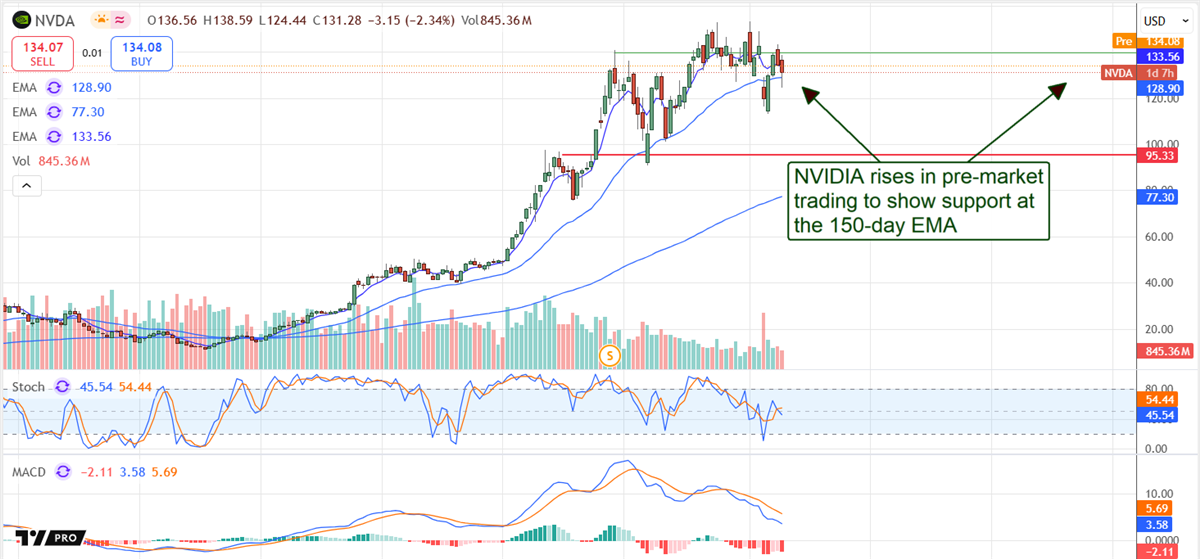 Read This Story Online | |
| Written by Leo Miller 
U.S. auto giant General Motors (NYSE: GM) recently made headlines with the announcement of a new $6 billion share buyback program. This move continues the company’s aggressive efforts to reduce its outstanding share count. But what’s the reasoning behind GM’s decision to allocate such a large sum toward repurchasing its own stock? More importantly, does this latest buyback make GM a more investable stock? Let's break down the announcement and discuss what it all means for investors. Breaking Down GM's Big Buyback Announcement The GM announcement had several important details. The company will quickly make $2 billion worth of these repurchases using an accelerated share repurchase (ASR) program. Through an ASR, companies work with investment banks to quickly buy back lots of shares. The result is that the company can immediately reduce its share count, boosting earnings per share (EPS). Ultimately, the company pays the bank higher fees for the speed of the repurchase. There is also a risk that shares could drop over the next few months, meaning the company could have bought back more shares if it had waited. GM possibly sees its shares as significantly undervalued at this point, meaning it is willing to prioritize speed in this transaction. The ASR is expected to be finished sometime within Q2. It is also important to understand how much the company is planning to spend on buybacks in relation to the value of the firm. With the new repurchase plan, the company now has $6.3 billion in buyback capacity. That represents over 13% of GM’s $48 billion market capitalization as of the February 26 close. That is a very significant amount. It is important to note that this new repurchase program, although significant, is still smaller than the company’s buyback spending over the recent past. Since the beginning of 2024, GM has spent more than $7 billion on buybacks. Over that time, the company’s shares have appreciated by over 35%. However, this is certainly not all due to buybacks. Over that period, the company has significantly beaten estimates on revenue and earnings every quarter. Overall, these lower numbers suggest the new repurchase plan will have less of an effect than the previous one. This is especially true given the stock’s significant rise in shares. Still, on the day of this press release, shares of GM appreciated nearly 4%, showing that markets are supportive of the move. This rise is similar to the 4% of shares the company could have bought back with the ASR based on the share price the day before the announcement. This suggests that the effect of the ASR may already be largely priced in. Assessing GM’s Dividend Boost Another factor influencing the rise in GM shares is the announcement of a substantial increase in the company’s dividend. Its dividend will rise by 25% to $0.15 per share. This gives the stock an indicated dividend yield of just over 1.2%. That is in line with the dividend yield of the S&P 500 Index. The absolute quarterly payment is now equal to that of rival Ford Motor (NYSE: F). However, Ford still maintains a massive advantage on this metric with an indicated yield of nearly 8%. Its other Big Three rival, Stellantis (NYSE: STLA), boasts a yield of 9.2%. However, this is largely because GM chooses to return capital to shareholders through buybacks over dividends. The combination of GM’s dividend and buyback yields over the last 12 months is over 15%. This sits below Stellantis’ 21%, but above Ford’s 9%. GM Buybacks: Confirms the Priors of Bulls, but Little Changes for Fence Sitters GM's new buyback program doesn’t greatly change the calculus when considering an investment in this name. This is because it doesn’t represent a significant change in terms of GM’s buyback pace. However, it does show a continued commitment to this strategy and should help support the share price. It also shows continued confidence from the management team, which is a good sign for those who were already liking this company. GM shares will continue to trade largely based on earnings and tariff news relating to Canada and Mexico. A large amount of its production takes place in these countries. GM posted record diluted-adjusted EPS in 2024. Its guidance shows management thinks the company will do so again in 2025. Read This Story Online | |
| More Stories |
| |
|
|