
Worst News for Stocks in 50 Years
Wall Street’s declared what could be the worst news for the U.S. stock market in 50 years.
If Goldman Sachs and Morgan Stanley are right... this won't be like the crashes we're used to. What's about to hit America next could keep your portfolio in the red for 10 years or longer - unless you make a big change now.
To hear about this decade-long crisis now being predicted by multiple Wall Street banks...
And to see what you can do to prepare your wealth before this hits...
Click here to learn how to defend your portfolio.
Regards,
Keith Kaplan
CEO, TradeSmith
P.S. You may have noticed we see "surprise" crashes every year now. Think about it: rate spikes in 2022... the bank crisis in 2023... $8 trillion wiped out in 2024... $11 trillion wiped out during the tariff crash in 2025... and, this year, $12 trillion was wiped out in 30 days during the Iran War. Something is off and Wall Street suggests this could continue (and worsen) well into the 2030s. Click here to learn the truth about this market and see what you must do now to prepare.
Why AppLovin’s CEO Is Selling While Quantum Insiders Are Buying
By Leo Miller. Originally Published: 6/30/2026.
Key Points
- Wall Street analysts forecast more than 30% upside for AppLovin, Quantinuum, and ServiceTitan despite notable insider trading activity across all three stocks.
- Quantinuum saw more than 10 insiders purchase nearly $25 million in shares following its IPO, an unusually bullish signal given that insiders typically sell post-IPO.
- AppLovin CEO Adam Foroughi sold approximately $51 million in discretionary shares in June, though he retains a stake valued at more than $1 billion.
- Special Report: Everyone wanted SpaceX. Smart money wants this.
Insiders are making notable trades across several tech stocks. That includes the newest quantum stock on the market, which is seeing significant insider purchases right out of the gate. Meanwhile, insiders are selling two other notable software companies. Still, when it comes to analyst forecasts, upside is something all three have in common.
AppLovin CEO Sells More Than $50 Million in Discretionary Move
First up is advertising technology giant AppLovin (NASDAQ: APP). The company stormed onto the stock market scene in 2024, delivering a massive return of more than 700%. It added to that with a gain of over 100% in 2025. However, AppLovin has had a much tougher stretch in 2026, falling 25%. That decline stems from several factors, including AppLovin’s high 2025 valuation and broader software stock weakness. Notably, in Q4 2025, AppLovin traded at a forward price-to-earnings ratio as high as 59x. That figure has since fallen to around 31x.
BlackRock hit $2.8 billion in three months on this new financial grid (Ad)
Larry Fink, CEO of BlackRock - the world's largest asset manager with $10 trillion under management - is calling this 'the next major evolution in market infrastructure.' He's referring to a complete overhaul of America's financial system, and by law the entire $382 trillion U.S. financial system must migrate onto it by April 2027.
BlackRock launched a fund on this new infrastructure and hit $2.8 billion in assets in three months. JPMorgan is running $2 billion a day through it. Goldman Sachs, Citi, Bank of America, and Wells Fargo have all announced full integration. The digital fuel powering this grid is up 374% over the last five years.
Get the ticker and full positioning guide behind the $382 trillion migrationIn addition, the company’s most prominent executive, CEO Adam Foroughi, is selling shares. Overall, Foroughi has sold approximately $51 million worth of AppLovin shares in June. Notably, none of these sales came under a predetermined 10b5-1 plan, indicating that they were discretionary.
However, this is relatively common for Foroughi. He made other large non-10b5-1 sales in March 2026 and November 2025. Furthermore, Foroughi continues to hold a massive stake in AppLovin. After these reported sales, he still owns more than 2.3 million shares, worth over $1 billion at recent prices. Despite the CEO’s substantial discretionary insider sales, the moves are not especially concerning given these mitigating factors.
Quantinuum: Insiders Spend Big on Quantum’s Newcomer
Quantinuum (NASDAQ: QNT) is the new kid on the block in quantum computing stocks. The company recently completed its IPO, opening at $60 per share. Since then, the stock has posted solid gains, rising more than 15%. Notably, many insiders increased their stakes in the company right after the IPO, buying at the $60 price. In total, more than 10 separate insiders purchased shares, with total buys amounting to nearly $25 million.
That is interesting, considering that insiders tend to already have large positions in their company prior to an IPO. In fact, insiders often look to offload shares after an IPO to gain liquidity. As a result, these buys send a more bullish signal than standard insider purchases.
While Quantinuum shares have risen substantially from their opening price, those gains have not been dramatic to date. That makes it more likely than not that insiders continue to see long-term upside.
Nonetheless, Quantinuum faces risks similar to those of many quantum stocks. The most notable are valuation and cash burn. The company generated $5.2 million in revenue in Q1, posted a net loss of $136.6 million, and still has a market capitalization of around $19 billion. This reflects the long-term expectation among many investors that quantum computing will eventually become a large and profitable industry. Along the way, the U.S. government is providing support for the industry.
ServiceTitan’s Insider Sales Rise, But Remain Far Below 2025 Levels
ServiceTitan (NASDAQ: TTAN) went public in 2024 and was one of the more hotly anticipated IPOs at the time. The company provides cloud-based software that brings technology to the trades. Targeting industries like plumbing, roofing, and carpentry, ServiceTitan’s software offers sales, marketing, customer management, and job scheduling solutions.
After delivering a modest 3.5% gain in 2025, the market has crushed ServiceTitan shares in 2026, with the stock down more than 30%. Much of that decline has come from the broader software sell-off.
The firm has also seen a meaningful rise in insider sales in Q2, with most of those sales coming in late June. Overall, total sales of $16 million in Q2 are up sharply from less than $7 million in Q1. Furthermore, none of these sales came under a 10b5-1 plan.
It is important to note that ServiceTitan’s overall insider sales remain far below their peak. In Q3 2025, ServiceTitan’s insider sales totaled $172 million. Given that backdrop, the company’s recent sales are not overly worrisome. Meanwhile, ServiceTitan continues to grow revenues by more than 20% and improve profitability significantly. In its latest quarter, adjusted operating margin more than doubled from the prior year, rising from 7.5% to 15.2%.
Analysts Eye Big Gains Across AppLovin, Quantinuum, and ServiceTitan
Notably, Wall Street analysts are forecasting significant gains across all three stocks. For ServiceTitan, the MarketBeat consensus price target is near $110, implying more than 55% upside. For AppLovin, analysts are projecting upside north of 30%, with the MarketBeat consensus price target near $668. Meanwhile, a number of analysts recently initiated coverage on Quantinuum. The average of those targets is just under $99, also implying upside of more than 35%.
Cerebras Systems, Inc: The Next Rags-to-Riches AI Story?
Submitted by Thomas Hughes. Article Published: 6/25/2026.
Key Points
- Cerebras Systems targets the $125 billion AI inference market with chips that deliver double to triple the token-generation throughput of traditional GPU setups.
- Key growth catalysts include revenue-generating deals with OpenAI and AWS, supply chain insulation from HBM shortages, and the ability to ramp production ahead of competitors.
- Ten of 11 analyst ratings are Buys, with the consensus price target approximately 60% above late-June levels, as analysts view company guidance as conservative.
- Special Report: Everyone wanted SpaceX. Smart money wants this.
In a world where bigger is better, Cerebras Systems (NASDAQ: CBRS) appears to be well positioned. Instead of linking numerous AI cores together and creating data-transfer bottlenecks along the way, Cerebras chips are massive—comparable to dinner plates—and house thousands of cores on each one.
The advantage of this approach is straightforward: speed. Housing AI cores on a single chip enables lightning-fast performance that traditional GPU technology cannot match. The trade-off is memory capacity: NVIDIA’s (NASDAQ: NVDA) Vera Rubin natively supports far more memory, making it the superior choice for training and advanced applications.
BlackRock hit $2.8 billion in three months on this new financial grid (Ad)
Larry Fink, CEO of BlackRock - the world's largest asset manager with $10 trillion under management - is calling this 'the next major evolution in market infrastructure.' He's referring to a complete overhaul of America's financial system, and by law the entire $382 trillion U.S. financial system must migrate onto it by April 2027.
BlackRock launched a fund on this new infrastructure and hit $2.8 billion in assets in three months. JPMorgan is running $2 billion a day through it. Goldman Sachs, Citi, Bank of America, and Wells Fargo have all announced full integration. The digital fuel powering this grid is up 374% over the last five years.
Get the ticker and full positioning guide behind the $382 trillion migrationThat said, Cerebras Systems' speed makes its AI technology especially well suited to real-time inference, the much larger market.
Cerebras Set to Dominate in the AI Inference Market
Currently estimated at approximately $125 billion as of mid-2026, the inference market is expected to grow at a solid double-digit compound annual rate for at least the next four to five years, roughly doubling over that period. While GPUs remain the foundation for inference, hardware demand is expanding to include more specialized equipment better suited to the task.
Cerebras's other advantages include the far simpler programming required compared to multi-GPU setups, a smaller footprint—since one Cerebras chip can replace dozens of servers—and lower operating costs. For comparable computing power, the chips deliver industry-leading speeds, often generating tokens at two to three times the throughput of traditional GPU setups, depending on the model.
CBRS Pulls Back to IPO Lows With Catalysts in Play
Cerebras Systems has several catalysts in play, including a growing number of business deals, insulation from supply-chain bottlenecks, and new product launches. Deals such as those with OpenAI and Amazon’s (NASDAQ: AMZN) Amazon Web Services are generating revenue now and are expected to ramp in upcoming quarters.
OpenAI is currently porting GPT 5.4 and GPT 5.5 to Cerebras infrastructure and plans to deploy 750 megawatts of its own capacity soon.
The deal with AWS promises to generate a rapidly growing revenue stream through a disaggregated inference setup: AWS's Trainium chips handle the prefill stage—processing the input—while Cerebras's CS-3 systems run the high-speed decode stage that generates the output tokens.
Other catalysts for Cerebras include manufacturing and construction that do not require high-bandwidth memory (HBM), insulating the company from industry bottlenecks. The result is that Cerebras can ramp production of its chips while others are forced to wait on memory modules, putting it in a position to gain market share quickly.
Hurdles Drive Volatility for CBRS Shareholders
However, as strong as the outlook may be, the company still has hurdles and headwinds to overcome. Among them is customer concentration, as revenue relies on a limited number of hyperscalers, including the United Arab Emirates-backed G42 Holdings, Ltd. That exposure brings government scrutiny and export controls into the picture. Meanwhile, the sharp increase in inference demand forced the company to lease back previously committed capacity, temporarily weighing on margins.
The more pressing concern is competition. In-house chips are aiming to achieve much of what Cerebras Technology is doing, and there is also the memory shortfall to consider. While Cerebras chips are exceptionally fast, they have limited on-chip memory, which affects their usefulness in some applications.
While the systems are excellent at producing output, they struggle with input and need front-end assistance with massive prompts, such as enterprise-grade requests based on potentially endless datasets. The deal with Amazon is one example, as Cerebras systems need the Trainium infrastructure to sort and organize data into digestible bites it can use to generate super-fast responses.
The company’s plan is to increase memory capacity over time by shrinking the size of the SRAM modules within each chip. It has done so successfully across several generations and is on track to do so again with its upcoming technology. The caveat is that there is a physical limit to how much can be placed on a single wafer, because nodes can only get so small.
Optimistic Analysts Highlight Value Opportunity in CBRS Stock
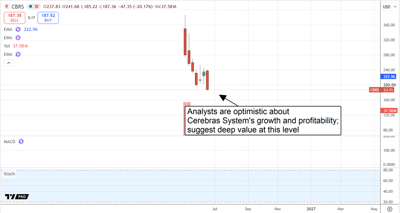
The initial analyst outlook for Cerebras is bullish. The first 11 reports to appear on MarketBeat’s tracking page since the IPO include 10 Buy ratings, reflecting a 92% Buy-side bias. The group sees the stock as fairly valued near its IPO level, approximately 60% above the late-June price action. The risk is that price action could continue selling off, as is often the case with IPO stocks, but the analysts' commentary suggests otherwise. They view company guidance as conservative and expect strengths to emerge as the year progresses.
Among those strengths is the potential for accelerated gross margin expansion. The combination of capacity ramping and rising compute costs creates a dual lever for growth. In this scenario, CBRS will likely outperform its guidance in the upcoming quarters and improve its profitability outlook.
As it stands, profits are expected by next year, and profitability is projected to improve aggressively over the subsequent three to five years.
This email message is a paid advertisement provided by TradeSmith, a third-party advertiser of MarketBeat. Why was I sent this message?.
This ad is sent on behalf of TradeSmith at 1125 N. Charles Street, Baltimore, Maryland 21201. If you’re not interested in this opportunity, please click here.
If you have questions or concerns about your newsletter, feel free to contact MarketBeat's South Dakota based support team at contact@marketbeat.com.
If you would no longer like to receive promotional emails from MarketBeat advertisers, you can unsubscribe or manage your mailing preferences here.
Copyright 2006-2026 MarketBeat Media, LLC. All rights protected.
345 N Reid Place, Suite 620, Sioux Falls, SD 57103-7078. United States of America..