
Dear Friend,
A drilling crew near the Grand Canyon just confirmed what the International Energy Agency calls one of the largest energy resources ever measured.
Enough to meet global electricity demand 140 times over.
Not 140 percent. One hundred and forty times.
Everyone knew the energy was there. Reaching it was the problem - miles of solid rock.
That changed last year.
A crew drilled nearly three miles down in 16 days.
The Department of Energy said it would take 64.
They weren't after oil.
They were after the heat.
Google already signed a 15-year deal. Bill Gates wrote a $100 million check. And on August 18th, Washington hands this resource an edge no other energy source has.
One company sits at the center.
See the company behind the Grand Canyon discovery >>
“The Buck Stops Here,”
Kelly Maguire
Behind the Markets
Palantir's CEO Just Called Out OpenAI and Anthropic
Author: Chris Markoch. Date Posted: 7/7/2026.
Key Points
- CEO Alex Karp told CNBC that enterprises risk losing their competitive data advantage by relying on frontier AI models like OpenAI or Anthropic.
- Critics, including Michael Burry, argue Karp is talking his book amid PLTR's 25% decline in 2026, but Palantir's earnings have not shown lost business.
- Karp projected $15 billion to $18 billion in free cash flow within two years, though PLTR still trades below its 200-day EMA of $143.43.
- Special Report: SpaceX is offering you shares. Don't take them.
Palantir Technologies (NASDAQ: PLTR) is not known for shying away from controversial topics. However, when it comes to frontier large language models (e.g., Anthropic, OpenAI), Palantir had been pulling its punches.
That changed in a recent interview Palantir co-founder and CEO Alex Karp gave to CNBC. In the interview, Karp said what the company’s business model has suggested for years: the real AI trade isn't the foundation-model layer; it's the application and integration layer that sits on top of it.
Elon’s big $266,000 per second purchase (Ad)
Elon Musk bought Super Bowl ad time at $266,000 per second - something he has never done before. 125 million Americans watched, but Whitney Tilson, former manager of a $200 million hedge fund, says most investors missed what it actually means.
With 1 in 3 Super Bowl viewers using buy-now-pay-later services and 40% of Americans carrying more credit card debt than savings, Tilson believes Elon's message reveals a major economic current - and a clear signal for where smart money should be positioned.
Watch Tilson's free presentation to see what he thinks you should do nowIn the interview, Karp remarked that enterprises want to "own the means of production" instead of "transferring their alpha" to OpenAI or Anthropic. In plain English, Karp was warning that an enterprise's competitive edge (i.e., its alpha) is its data.
If that data runs through another company’s API, they are renting a moat, not building one.
The real danger comes if those companies use the data they acquire to work against the enterprises with which they’re doing business. According to Karp, that is not a concern with Palantir.
How Frontier AI Models Could Become Enterprise Competitors
When an enterprise company pays a frontier model company, they’re buying the ability to, in industry terms, bolt a chatbot onto their workflow. The value and pricing power flow to the model maker. In the process, the enterprise loses exclusive ownership of that data.
With Palantir, a company is buying Ontology/AIP to embed AI directly into its own proprietary data and decision-making. The value of that data stays in-house.
The threat Karp is describing isn't hypothetical. Enterprises that route their proprietary data through a frontier model risk handing over their know-how, trade secrets, and competitive edge to a company that may eventually compete with them directly.
That risk is becoming harder to ignore. For an enterprise, real data safety means maintaining control over its own data, model weights, and compute resources. Without that control, a frontier lab can absorb a company's proprietary knowledge and repurpose it into its own product.
Anthropic's expansion into vertical-specific offerings illustrates the pattern. Categories once served by independent developers building on top of Anthropic's models are increasingly being served by Anthropic itself. The model maker sees where value is created on top of its platform, then moves in to capture it directly.
The logic is straightforward: a company with a dominant model can use that position to expand into adjacent, high-value verticals over time. It's the same dynamic Karp is pointing out. If enterprises hand over proprietary data, they may be arming a future competitor.
Is Alex Karp Defending Palantir or Highlighting a Real AI Risk?
Critics of Karp’s statement argue that he is simply talking his book. Some see frontier models as a direct threat to Palantir’s business. Michael Burry went so far as to say that Anthropic was “eating Palantir’s lunch.”
The criticism gains more traction with PLTR down 25% in 2026 and approximately 35% below its all-time closing high around $207 in November 2025. The thinking is that Karp is trying to prop up the stock by discrediting the competition.
However, the crux of Karp’s argument is what many analysts have been saying for months. Palantir operates at a different layer of the AI stack. Its role is to orchestrate the application layer via its Ontology, which is agnostic to whatever large language model (LLM) enterprises choose to use.
A more relevant critique is that foundation-model companies are moving downstream too (custom GPTs, enterprise tooling), so the "layer" distinction may blur over time. However, Palantir’s earnings reports to date don’t indicate that the company is losing business. In fact, the opposite appears to be true.
Can Palantir's Long-Term Growth Outlook Justify PLTR's Valuation?
Palantir will continue to face concerns about its valuation. No matter how much the company grows, many investors believe that there’s too much future growth priced into PLTR.
So far, betting against that future growth hasn’t been a good bet. But what comes next? According to Karp in the interview, Palantir has “...more business than we can supply. [...] 2 years out, you can see 15 ... 18 billion dollars of free cashflow.”
That will fire up the skeptics. However, in 2022, Karp announced a 2025 revenue target of $4.5 billion. In 2025, the company’s full-year revenue was $4.475 billion. Like it or not, Karp has a history of backing up forecasts that first look audacious.
That makes the case for owning PLTR for the long haul. However, in the near term, PLTR's chart tells a story of stalled momentum, not full recovery. The stock still trades below its 200-day EMA of $143.43. That’s a level that continues to act as resistance.
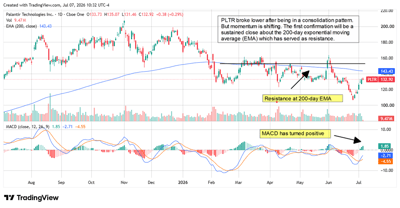
There are signs of stabilization: the MACD has turned positive after months in negative territory, signaling early bullish momentum following the June lows near $106. But until PLTR reclaims its 200-day EMA, the longer-term trend remains bearish. Karp's comments may be fueling sentiment, but the charts show a stock still searching for confirmation.
As Employers Drop Obesity Drug Coverage, Hims & Hers Could Be the Winner
Author: Jessica Mitacek. Date Posted: 7/6/2026.

Key Points
- Employers are expected to drop coverage for GLP-1 weight-loss drugs in 2027, potentially driving patients toward Hims & Hers Health's telehealth subscription platform.
- Hims & Hers shares have surged more than 45% in 30 days and about 160% since their February low, leaving the stock technically overbought.
- Wall Street remains largely cautious on HIMS, with a consensus Hold rating, rising short interest, and increased insider selling despite the stock's rally.
- Special Report: SpaceX is offering you shares. Don't take them.
The healthcare sector has been one of the best-performing sectors in the S&P 500 over the past month, gaining roughly 6%. While that rebound has been led by a handful of mega-cap Big Pharma companies, it has also shown up in the performance of smaller firms.
One of those companies is mid-cap Hims & Hers Health (NYSE: HIMS), the telehealth platform that provides direct-to-consumer (D2C) personal care products and virtual medical services.
Elon’s big $266,000 per second purchase (Ad)
Elon Musk bought Super Bowl ad time at $266,000 per second - something he has never done before. 125 million Americans watched, but Whitney Tilson, former manager of a $200 million hedge fund, says most investors missed what it actually means.
With 1 in 3 Super Bowl viewers using buy-now-pay-later services and 40% of Americans carrying more credit card debt than savings, Tilson believes Elon's message reveals a major economic current - and a clear signal for where smart money should be positioned.
Watch Tilson's free presentation to see what he thinks you should do nowOver the past 30 days, HIMS has climbed more than 45%, pushing the stock’s year-to-date (YTD) gain to nearly 20%. After a move like that, the stock may be due for a short-term breather. But according to healthcare industry experts, a looming catalyst could have an outsized benefit for Hims & Hers in 2027 and beyond, setting the stock up as a buying opportunity on its next pullback.
The GLP-1 Craze Is Pushing Up Employers’ Healthcare Plan Costs
As the cost of weight-loss drugs continues to rise, Reuters recently reported that some employers are planning to drop coverage for GLP-1 treatments, including Wegovy, Ozempic, Zepbound, Mounjaro, and Foundayo—products manufactured by Novo Nordisk (NYSE: NVO) and Eli Lilly (NYSE: LLY).
Last year, more than 40% of employers covered weight-loss drugs, and estimates for this year are roughly the same. But analyses from two industry groups cited by Reuters suggest that may change in 2027.
According to policy research group Business Group on Health, about 10% of employers that currently offer coverage for GLP-1 drugs for weight loss said they plan to drop it in 2027. A second survey by Mercer, a benefits consultancy, found that 5% of large employers plan to drop coverage in 2027 or are actively considering it.
While that is unfortunate news for those undergoing treatment, it is welcome news for HIMS shareholders. Patients losing healthcare coverage for GLP-1 drugs could be a boon for Hims & Hers Health, which currently generates around one-third of its revenue from its weight-loss business.
Analysts expect the company’s revenue to grow from an estimated $2.89 billion in 2026 to $3.45 billion in 2027, and increased subscription demand for weight-loss drugs amid shrinking insurance coverage should play a significant role in that top-line growth.
Lost coverage for GLP-1 treatments should also spur a migration to D2C telehealth providers, with Hims & Hers serving as a natural destination thanks to its platform, which bundles medical provider access, unlimited clinical consultations, and pharmacy fulfillment services into one streamlined subscription.
Technical Analysis and Wall Street Suggest a Correction Is Ahead
With its recurring revenue model, Hims & Hers should be a long-term beneficiary of dropped coverage. The platform charges a $39 fee for the first month of its weight-loss membership. After that, the charge rises to $149 for clinical subscriptions, not including the cost of the medication itself. Medication is billed separately, and Hims says the membership does not include or guarantee a prescription. Compounded oral options, for instance, can run from $145 to more than $199 per month, while branded GLP-1 pens—like Wegovy—can cost even more.
However, following its roughly 160% gain from its YTD low on Feb. 27, HIMS appears overdue for a price correction. According to the Relative Strength Index (RSI)—a technical momentum indicator that shows whether a stock is overbought (above 70), oversold (below 30), or fairly valued (somewhere in between)—HIMS has moved into overbought territory.
As shown by the green arrow below, the RSI on HIMS' one-year chart currently reads 70.86, suggesting that the stock is overbought and due for a price reversal:
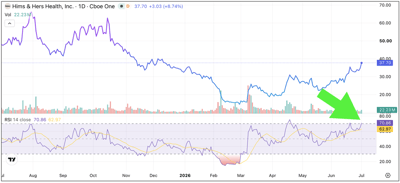
Technical analysis is hardly a perfect science. But the last two times the stock’s RSI breached 70—first in mid-April and then again in mid-June—HIMS pulled back more than 28% and nearly 8%, respectively, before continuing its rally.
Meanwhile, Wall Street remains bearish on the stock after its outperformance this year. Of the 16 analysts currently covering HIMS, only four assign it a Buy rating.
Overall, the stock receives a consensus Hold rating alongside a 12-month price target that implies more than 19% potential downside from current prices.
Concerningly, with a high-volatility beta of 2.35, current short interest in HIMS now stands at more than 32% of the float, or about 65.4 million shares valued at $1.97 billion.
That is the highest the stock has been shorted since March and marks a nearly 5% month-over-month increase.
At the same time, insider activity has seen an uptick in selling this year. In Q1 2026, $3.46 million worth of HIMS shares were sold with no buys. In Q2, that figure rose to $4.86 million sold against $1.17 million bought.
This email communication is a sponsored email from Behind the Markets, a third-party advertiser of MarketBeat. Why did I get this email message?.
If you need help with your newsletter, please contact MarketBeat's U.S. based support team at contact@marketbeat.com.
If you would no longer like to receive promotional emails from MarketBeat advertisers, you can unsubscribe or manage your mailing preferences here.
© 2006-2026 MarketBeat Media, LLC.
345 N Reid Place #620, Sioux Falls, S.D. 57103. USA..