
| Unsubscribe |
Quick question...
Would you spend 60 seconds to save yourself $29.97?
That's what my "Safe Trade Options Formula" book costs on our website right now. But today, I'm giving it away — no charge, no strings.
Inside, you'll discover a 5-part trade that makes every trade... a SAFE TRADE.
It's the same book that sells for $29.97 on our website right now, but is yours on the house today.
All you have to do is click here and tell me where to send it.
Good Trading,
Bill Poulos
p.s. This won't stay free forever — $29.97 is a fair price and I'll be going back to it soon.
Grab your copy here before that happens.
AeroVironment Flies Under Wall Street’s Radar Toward a $4 Billion Target
Reported by Jeffrey Neal Johnson. Posted: 7/10/2026.

Key Points
- AeroVironment’s fiscal 2030 targets triggered analyst concern about execution risk, even as management pointed to strong long-term demand.
- AeroVironment’s fiscal fourth-quarter results showed record revenue, strong adjusted EBITDA and a larger funded backlog.
- The company’s counter-drone contract wins support the bullish case, but investors still need to weigh valuation, integration risk and the timing of government spending.
- Special Report: SpaceX is offering you shares. Don't take them.
Wall Street analysts panicked recently when AeroVironment's (NASDAQ: AVAV) management unveiled an aggressive revenue target of $3.5 billion to $4 billion for fiscal 2030. The immediate reaction was a wave of synchronized downgrades, with analysts citing significant execution risk and flat macroeconomic defense budgets.
The resulting sell-off contributed to a 38% year-to-date pullback, pushing AeroVironment's stock price close to its 52-week low. When institutional players hyper-focus on near-term organic guidance, they often miss the broader structural shift unfolding in plain sight.
One webinar worth putting on your calendar. (Ad)
Sean Allison is hosting a free presentation on what he calls the Zero-Dollar Trade Advantage - a trading approach designed to help everyday investors participate in the market more strategically.
Whether you trade daily or occasionally, this session is built to offer a concrete alternative perspective - not a pitch, just a method.
Reserve your free seat for the Zero-Dollar Trade Advantage session nowThe prevailing narrative suggests AeroVironment needs a miraculous, back-weighted acceleration to hit its 2030 goals. Analysts looked at the projected 10% organic growth for fiscal 2027 and concluded that the math for the end of the decade was too difficult to achieve. This skepticism triggered a sharp repricing, creating a steep discount for investors willing to look past headline volatility.
Clearing the Air on the 2030 Roadmap
A closer examination of recent financial metrics, strategic acquisitions, and immediate contract monetization reveals a different reality for AeroVironment. The underlying growth trajectory is not only visible but also effectively derisked by recent operational execution. The data points to a stark disconnect between price action and business fundamentals.
Modern kinetic conflicts have fundamentally altered global military doctrine. The Pentagon is actively rerouting procurement budgets away from slow, expensive legacy platforms like fighter jets and into attritable unmanned systems and Counter-UAS technology. AeroVironment is positioned as a premier pure-play asset in this space, making the macroeconomic argument about flat defense budgets largely irrelevant to its specific product suite.
Profitability Takes Flight in Fiscal Q4
Understanding the valuation disconnect requires looking at the raw data from the fiscal fourth quarter of 2026. AeroVironment delivered a blowout earnings report, generating a record $642 million in quarterly revenue. This represents a 31% year-over-year organic growth rate. Most importantly, AeroVironment reported $140 million in Adjusted EBITDA, translating to a 22% margin.
This margin metric effectively neutralizes the primary bearish argument. Major firms downgraded the stock because they doubted management's ability to reach its stated 2030 target of 18% to 20% Adjusted EBITDA margins. The earnings data show AeroVironment is already operating comfortably above that threshold.
In the defense technology sector, operating leverage is a critical driver of shareholder value. As revenue scales through the mass production of unmanned systems, fixed engineering and administrative costs are spread across a larger base, sending more cash flow directly to the bottom line.
Analysts are actively pricing in severe margin compression to justify their lowered price targets, yet the most recent filings argue against that assumption. Management is not chasing a futuristic profitability goal; it is already executing above it today.
Securing the Shield With a $500M Army Contract
AeroVironment positioned itself well for the Pentagon's strategic pivot through the integration of BlueHalo. This acquisition nearly doubled AeroVironment's operational footprint and established a dominant position in the highly lucrative Counter-UAS market.
Proof of this strategic dominance arrived rapidly via a $500 million sole-source contract for the U.S. Army's JIATF-401 Domestic Shield Program. A sole-source award is a powerful vote of confidence. It means the Department of Defense bypassed the standard competitive bidding process entirely, viewing AeroVironment's technology as a unique, irreplaceable necessity.
Skeptics often argue that large government contracts take years to monetize, creating a lag between headline numbers and recognized revenue. However, AeroVironment immediately booked an $80.5 million task order against this vehicle for its Titan system. This swift conversion from theoretical contract value to tangible cash flow highlights a highly efficient procurement cycle.
This contract adds to AeroVironment's multi-year visibility. The defense contractor currently holds a $1.2 billion funded backlog alongside a sweeping $1.5 billion unfunded backlog. Funded backlog represents dollars already appropriated by Congress and assigned to specific deliverables, essentially guaranteeing future revenue. An unfunded backlog indicates indefinite-delivery vehicles in which the maximum value is set, but orders are placed incrementally over time. Together, these expansive $2.7 billion pipelines provide a thick layer of insulation against broader macroeconomic headwinds.
Catching Bears in the Crosshairs
The recent 38% price drop is heavily tied to market mechanics rather than fundamental deterioration. Short interest currently hovers around 12.6% of the float, translating to roughly 4.8 million shares sold short. The days-to-cover ratio is 4.6, indicating it would take nearly five days of average trading volume for short sellers to fully exit their positions.
This data frames the post-Investor Day sell-off as an aggressive short-selling distortion. Short sellers bet heavily on the execution risk narrative. When a business navigating negative trailing net margins trades at a forward price-to-earnings multiple of 44, it naturally attracts bearish speculators looking to capitalize on perceived overvaluation.
The bears are anchoring their thesis to trailing profitability metrics rather than forward cash flow and aggressive backlog conversion. As those newly minted task orders convert to recognized revenue at 22% margins, the fundamental floor beneath the stock rises.
A manufactured dip driven by weak hands and overzealous short sellers creates a highly volatile, asymmetric environment. If upcoming earnings reports continue to validate the $4 billion revenue roadmap, short sellers will be forced to buy back shares at higher prices to cover their positions, potentially triggering an upside re-rating for AeroVironment.
Preparing for a Permanent Shift in Procurement
The market is currently mispricing a premier growth asset in the defense technology space. While the 2030 targets sound highly ambitious on paper, the operational groundwork is firmly established and actively generating cash. The combination of record EBITDA margins, sole-source contract dominance, and a multi-billion dollar backlog paints a picture of a business quietly taking market share while Wall Street looks the other way.
Investors seeking exposure to the permanent shift in global military doctrine might view this volatility as a rare structural opportunity. The Pentagon's transition toward swarm drones and loitering munitions is not a temporary trend, but a permanent evolution of defense spending.
Cautious market participants may prefer to watch the next quarterly earnings report to confirm ongoing backlog monetization before taking a position. Those with a higher risk tolerance might consider the current valuation disconnect a compelling moment to evaluate AeroVironment before the broader market digests the reality of its long-term trajectory.
Buyer Beware: These 2 Stocks Charts Just Displayed a Death Cross
Reported by Jessica Mitacek. Posted: 7/10/2026.

Key Points
- Both Hertz Global Holdings and Kinross Gold recently formed death cross patterns, a bearish technical signal suggesting further downside price action may follow.
- Hertz has slashed its profit guidance, faced dilution concerns from a debt and borrowed-share offering, and hit a fresh 52-week low amid a consensus Reduce rating.
- Kinross Gold has fallen more than 39% since its all-time high as gold prices slumped, though short interest and institutional selling have both increased.
- Special Report: SpaceX is offering you shares. Don't take them.
Of all the bearish indicators in technical analysis, there is perhaps none more ominous than the death cross.
For beaten-down stocks, this trend-confirmation pattern appears when the short-term 50-day moving average crosses below the long-term 200-day moving average, suggesting more downside could lie ahead.
This might change how you think about trading. (Ad)
Sean Allison is hosting a free presentation on what he calls the Zero-Dollar Trade Advantage - a trading approach designed to help everyday investors participate in the market more strategically.
Whether you trade daily or occasionally, this session is built to offer a concrete alternative perspective - not a pitch, just a method.
Reserve your free seat for the Zero-Dollar Trade Advantage session nowAlthough sharp pullbacks and corrections can sometimes mark a potential bottom, hint at a reversal, and create a buying opportunity, the death cross often signals that bearish momentum is strengthening.
That is likely the case for Hertz Global Holdings (NASDAQ: HTZ) and Kinross Gold (NYSE: KGC), as sentiment, ratings, and fundamentals all support what the death cross has already suggested. For investors searching for value opportunities, these two stocks may be best left off the watchlist.
Hertz: Dilution, Depreciation, and a Slashed Profit Outlook
Hertz has been here before, and not long ago.
The previous death cross on Hertz’s one-year chart occurred on Nov. 28.
It was followed by a 26% decline before the stock bottomed and rallied to its year-to-date high on April 20.
But a number of factors—many of which have remained in place since that prior death cross—came to a head in Q2. Hertz lowered its guidance to a range of $50 million to $80 million as weaker used-car values increased depreciation pressure across its rental fleet. At the same time, investor sentiment deteriorated further as the company raised capital through a $350 million debt package and a related $100 million borrowed-share offering, which involved more than 37 million borrowed shares and raised concerns about leverage and dilution.
Those factors culminated in a 41% single-day loss on June 24. Then, in early July, a second death cross appeared on Hertz’s one-year chart.
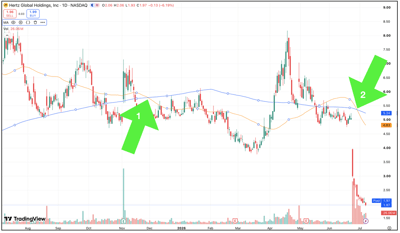
The stock recently hit a fresh 52-week low after losing nearly 60% in the past month alone and around 70% over the past year. Since its five-year high in November 2021, HTZ has plunged more than 94%.
Hertz has missed on earnings 10 of the last 13 quarters. In Q1, the company reported a 92% year-over-year decline in operating cash flow growth, while earnings per share (EPS) growth slipped more than 130% from the prior quarter.
On June 30, Morgan Stanley lowered its price target on Hertz from $5 to $3.50. The stock carries a consensus Reduce rating, short interest now exceeds 17% of the float, and HTZ sports a beta of 2.2, suggesting its recent bout of volatility is not yet in the rearview mirror.
As Gold Tumbles, So Too Does Kinross
Since the start of 2024, Kinross Gold has mirrored the record-setting gains in the precious metals market.
That years-long rally was good for gold stocks in general, but it was especially beneficial to Kinross, which operates six active gold mines in Brazil, Mauritania, and the United States.
The stock has gained more than 550% from January 2024 to Jan. 28, 2026, when it hit its all-time high (ATH).
But Q2 told a different story. After gold prices posted their worst quarterly performance in 13 years, Kinross fell out of favor with commodities traders.
Since its ATH, the stock is down more than 39%, and on the last day of June, a death cross emerged on KGC’s one-year chart:
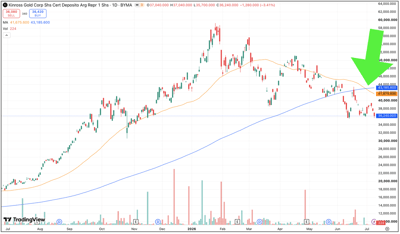
Because Kinross’s performance is closely tied to the spot price of gold, the stock sold off alongside the precious metal as investors locked in profits after a multi-year run-up. Gold is now mired in a bear market, and a rebound in the U.S. dollar, along with rising inflation, has fueled speculation about interest rate hikes that, if they materialize, could continue to encourage investors to rotate out of the metal and into yield-generating securities.
Kinross beat earnings in 13 of the last 14 quarters, and in 2025, the Toronto-based mining company reported record revenue, net income, and free cash flow. But the company’s forward production guidance is mostly flat at around 2 million ounces per year through 2027.
At the same time, CapEx has grown more than 56% from $764 million in 2022 to nearly $1.2 billion last year. Despite a Moderate Buy rating, short interest is currently 26% higher than it was the month prior, while institutional selling has increased in four of the past five quarters.
This email message is a paid sponsorship sent on behalf of Profits Run, a third-party advertiser of MarketBeat. Why was I sent this message?.
If you need assistance with your account, please feel free to email MarketBeat's South Dakota based support team at contact@marketbeat.com.
If you would no longer like to receive promotional emails from MarketBeat advertisers, you can unsubscribe or manage your mailing preferences here.
© 2006-2026 MarketBeat Media, LLC. All rights reserved.
345 N Reid Pl., Suite 620, Sioux Falls, S.D. 57103. USA..