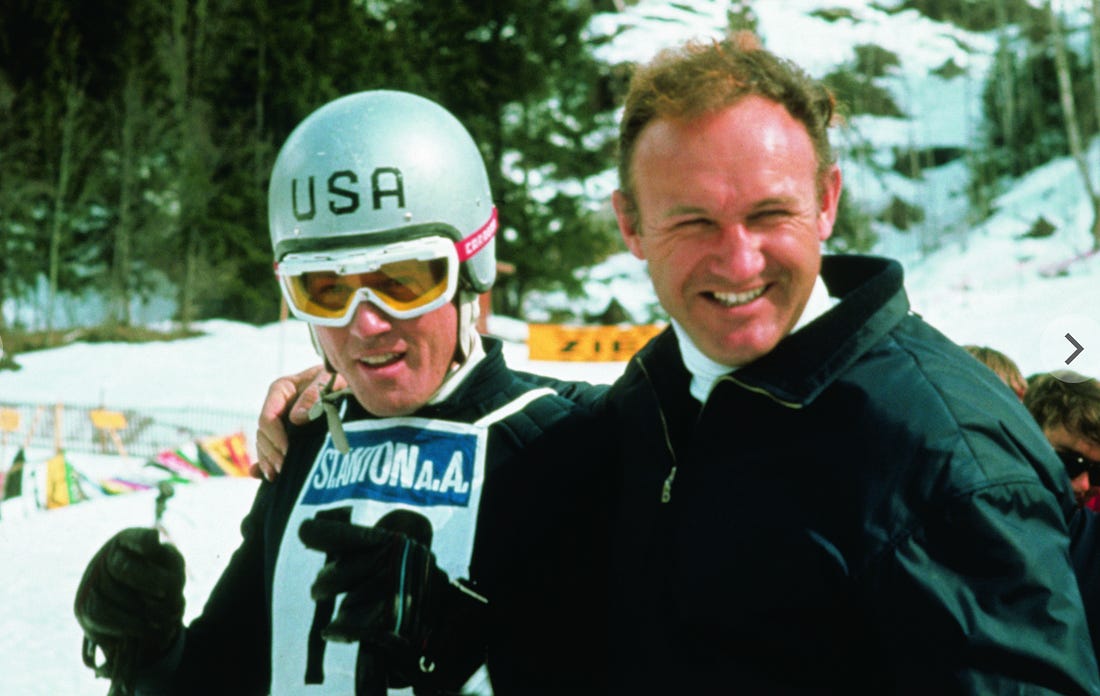
One last run in Park City: Robert Redford and Gene Hackman in Downhill Racer.
Dear Wags,
A few things happened on our way to Sundance. History chilled Park City like this month’s arctic blast. The upshot is that there doesn’t seem to be much room for make-believe in today’s America. Still, we’re going to squeeze in a few column inches for it just the same. You need a little relief from civil unrest.
Let’s take a moment to mourn the fact that Sundance is leaving Park City after 40 years and heading to Boulder. Boulder is an entirely worthy inheritor of the Sundance mantle: an urbane college town with better infrastructure, more hotel rooms, and fewer logistical headaches. Still, it doesn’t quite have the charm of a small resort burg high in the Wasatch Range, starry and unfussy at the same time, a place where you could watch groundbreaking Iranian cinema in a high school cafeteria.
That improbable mix of celebrity and intimacy, art-house seriousness and borrowed folding chairs, is what made Sundance feel less like an industry boondoggle and more like a reflection of its idiosyncratic founder, Robert Redford, who unabashedly loved movies and loathed studio artifice. What made Sundance great was its relatively pure-hearted focus on artistry. The festival’s exaltation of little movies that could—Sex, Lies, and Videotape, Hoop Dreams, Reservoir Dogs, The Blair Witch Project, The Big Lebowski, American Psycho, Capturing the Friedmans, The Squid and the Whale, Little Miss Sunshine, Winter’s Bone, Beasts of the Southern Wild, Whiplash, Boyhood, Call Me By Your Name, Get Out, Hereditary, Past Lives, If I Had Legs I’d Kick You—made it a creative, if increasingly unreliable, commercial engine.
This reflected Redford’s faith in the artistic temperament and his good fortune in coming of age during American cinema’s 1970s heyday, when creativity and commerce briefly aligned. Sundance’s evolution from a launchpad for buzzy theatrical releases into a feeder system for streaming platforms has not meant a decline in artistic quality. Quite the opposite. There were loads of great movies in Park City. If only they had the audiences they deserve.
This season, the festival’s last in Park City, carried a nip of melancholy. The week was charged with politics: a local man was charged with assaulting Democratic Congressman Maxwell Alejandro Frost at the High West Saloon, and a large anti-ICE protest moved down Main Street. There was also a quiet recognition that Redford’s golden age, and perhaps Sundance’s, belongs firmly to the past. You know the winds have shifted when a Little Miss Sunshine reunion panel makes you verklempt.
The screening of a restored version of Michael Ritchie’s 1969 Downhill Racer, starring Redford as a cocky American on the European ski circuit and a luminous Camilla Sparv as his love interest, reminded audiences just how glorious those days were. Still, this year’s crop of new films produced a few champions. Here’s what we liked.
Next year in Colorado.
—Marcello Rubini
The Wag Picks
Knife: The Attempted Murder of Salman Rushdie As audiences for original narrative films continue to shrink, Sundance has carved out a niche as the premier festival for prestige documentaries; all five of this year’s Oscar-nominated documentary features debuted in Park City. The class of 2026 includes several likely contenders, among them Alex Gibney’s intimate account of the assassination attempt on Salman Rushdie and its aftermath. Inspired by Rushdie’s memoir Knife: Meditations After an Attempted Murder, the film draws on footage shot by his wife, Rachel Eliza Griffiths, tracing not only his physical recovery but the return of an indomitable spirit.
The Friend’s House Is Here Timing is everything, and Maryam Ataei and Hossein Keshavarz’s quietly optimistic portrait of artists in Iran is slyly revolutionary, capturing a bohemia that stubbornly persists inside a theocratic police state. Like Jafar Panahi’s It Was Just an Accident, it’s a triumph of guerrilla filmmaking, shot under the regime’s nose—but it’s gentler, warmer, and more tender. Its premiere amid a state crackdown that has killed thousands lends the film added poignancy, while a U.S. travel ban that kept its female leads from attending the festival speaks as loudly about American hypocrisy as it does about Iranian repression.
Wicker A clarification: the Wicker Man in writer-directors Eleanor Wilson and Alex Huston Fischer’s goofball fable is not the guy who becomes kindling at the end of the classic British horror film. The stick figure at the center of this oddball tale is an artificial husband, fashioned by a local basket weaver (Peter Dinklage) for a smelly fisherwoman (Olivia Colman). Like a sexy Pinocchio, he comes to life in the form of Alexander Skarsgård. This development does not go down well with the town’s womenfolk, led by Elizabeth Debicki. Cue the splinter jokes.
The Invite Olivia Wilde was engaging in Greg Araki’s erotic thriller I Want Your Sex, playing a kinky Mrs. Robinson to Cooper Hoffman. Here, in The Invite, which she also directed, a high-strung couple (Wilde and Seth Rogen) invite their neighbors (Penélope Cruz and Ed Norton) to a catastrophic dinner party. Will McCormack and Rashida Jones’s script is an acid comedy of manners and politics. A24 snapped it up for a reason.
Josephine Beth De Araújo delivers a raw drama about an 8-year-old (Mason Reeves) dealing with trauma after witnessing a sexual assault in Golden Gate Park. Gemma Chan and Channing Tatum play the parents grappling with how to help their daughter heal. The real star here is San Francisco native Reeves, who was discovered at a local farmers’ market. It’s an arresting performance.
The AI Doc: Or How I Became an Apocaloptimist Daniel Roher and Charlie Tyrell’s exploration of the dangers and potential of artificial intelligence is ambivalent, funny, and totally accessible. AI moguls Sam Altman, Dario Amodei, and Demis Hassabis sat down with Roher for the film, but it’s not a sales pitch for technology; Roher’s wife, Caroline Lindy, acts as a foil when he gets too idealistic about AI’s promise. The doc is somehow hopeful, dark, and confused—a pretty good snapshot of public sentiment. It hits theaters in March.
Bedford Park Kitchen-sink dramas are becoming an endangered species, but Stephanie Ahn’s homespun romance—about a Korean American physical therapist (Audrey Moon) pulled into caring for her mother (Won Mi-kyung) after a Bronx car accident, and who finds herself falling for the tough guy (Son Sukku) who caused the crash—revives the form with grace. It’s a small picture from a big talent.
Ha-Chan Shake Your Booty! Josef Kubota Wladyka cha-chas into the ballroom-dance genre with this exuberant story about a lonely Tokyo woman (Rinko Kikuchi) who finds escape under the glitter ball. This isn’t the first time we’ve heard this tune, but the steps are executed by a very charismatic star.
Your Oscar Star Chamber
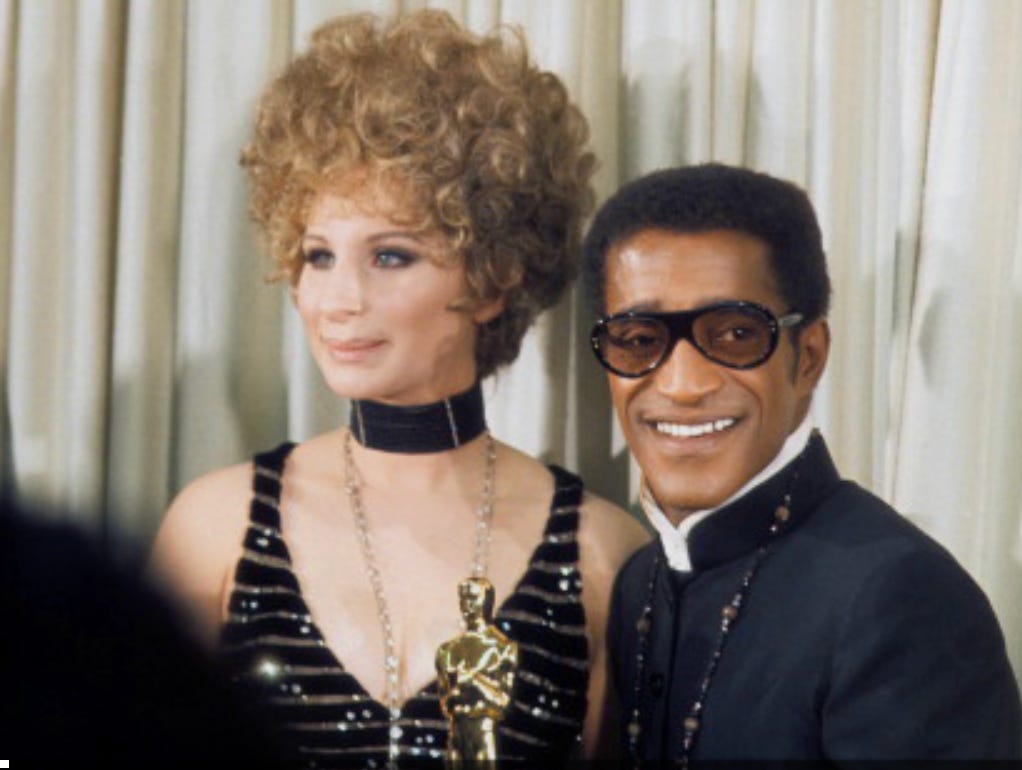
Barbra Streisand and Sammy Davis Jr. at the 1968 Oscars (Sammy was accepting Leslie Bricusse’s Academy Award for “Talk to the Animals” from Doctor Dolittle).
Our favorite book about the Academy Awards, Pictures at a Revolution by Wag Mark Harris, captured movieland at a moment of profound cultural shift. The five films nominated for the 1967 Best Picture Oscar—Bonnie and Clyde, The Graduate, Guess Who’s Coming to Dinner, In the Heat of the Night, and Doctor Dolittle—symbolized the collision of Old Hollywood and New. The New Hollywood was gone by the end of the 1970s, replaced by a corporate, blockbuster-driven era that is now itself a dim memory. The current Hollywood—or Crisis Hollywood—plummets into the unknown.
The best readers go Primo. Behind the velvet rope: exclusive CultureWag essays, recs, and high-priced swag. 🏆...