The Toro Company is on track to pay dividends and buy back shares in 2026, setting its stock price up for a reversal likely to be completed... ͏ ͏ ͏ ͏ ͏ ͏ ͏ ͏ ͏ ͏ ͏ ͏ ͏ ͏ ͏ ͏ ͏ ͏ ͏ ͏ ͏ ͏ ͏ ͏ ͏ ͏ ͏ ͏ ͏ ͏ ͏ ͏ ͏ ͏ ͏ ͏ ͏ ͏ ͏ ͏ ͏ ͏ ͏ ͏ ͏ ͏ ͏ ͏ ͏ ͏ ͏ ͏ ͏ ͏ ͏ ͏ ͏ ͏ ͏ ͏ ͏ ͏ ͏ ͏ ͏ ͏ ͏ ͏ ͏ ͏ ͏ ͏ ͏ ͏ ͏ ͏ ͏ ͏ ͏ ͏ ͏ ͏ ͏ ͏ ͏ ͏ ͏ ͏ ͏ ͏ ͏ ͏ ͏ ͏ ͏ ͏ ͏ ͏ ͏ ͏ |
| | Written by Thomas Hughes 
The Toro Company’s (NYSE: TTC) weekly stock chart suggests its bear market is over, a baby bull market has formed, and it’s gaining traction. Not only is the market showing clear support at long-term lows, aligning with prior price action, but support appears to be strengthening; the indications are strong, and a breakout is imminent. The breakout is the critical factor, signalling market commitment and a trigger point for investors, likely to spur an influx of new capital. The fundamentals are also critical factors for this industrial stock. A bullish-looking chart without a bullish story is nothing more than a bear market setting itself up for another run lower. In this case, while The Toro Company continues to face hurdles, it is navigating them well, widening margins, and is on track to resume growth in 2026. 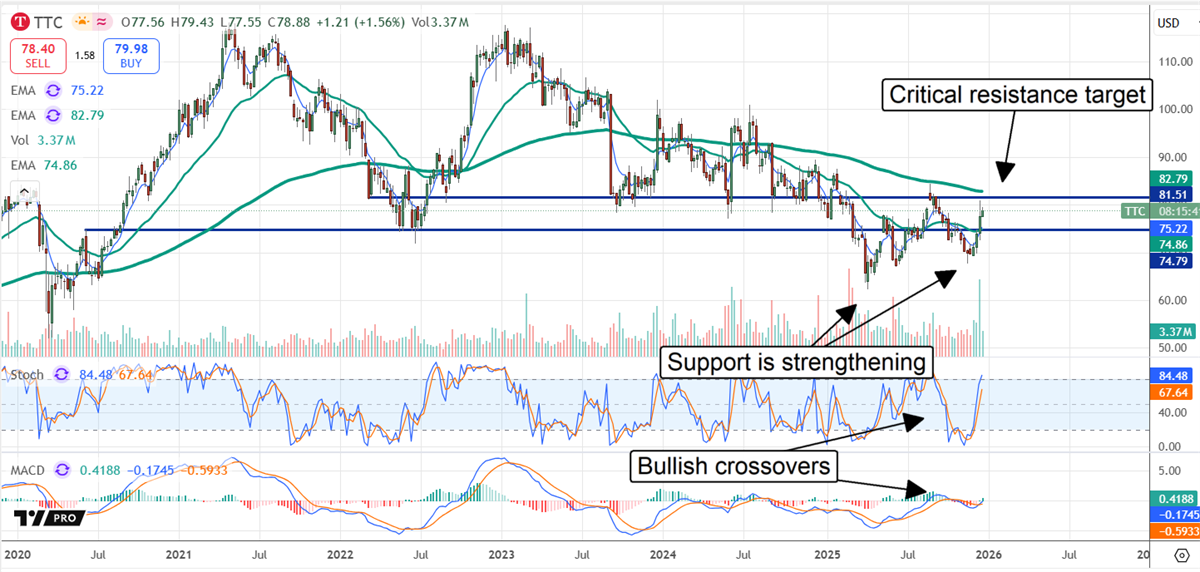
Market Gets AMPed on The Toro Company’s 2026 Outlook The Toro Company did not have a great 2025, with revenue contracting due to weakness in its consumer segment, but strength in the Pro segment offset it and was compounded by cost-saving efforts. The company’s AMP strategy is paying off, resulting in a 220 basis-point improvement in adjusted gross margin and significant outperformance on the bottom line. Investments in growth and technology, as well as the impact of tariffs, cut into earnings; however, adjusted EPS was more than 450 basis points ahead of MarketBeat’s reported consensus, free cash flow hit a record, and cost savings are forecast to continue in the upcoming year. Guidance is a driving force for this market and the capital return outlook. The company continues to expect a modest single-digit revenue gain in 2026 but has increased its earnings forecast from prior levels, giving a range whose midpoint exceeds the consensus target. The new guidance includes a 25% increase to the AMP savings target, expected to be realized by the end of fiscal year 2026 (FY2026), and an improved outlook for capital returns. The Toro Company’s capital return is attractive for investors. The company’s dividend, which yields about 2% as of the end of 2025, is safe at 35% of the earnings forecast and reliable, with a 22-year history of annual distribution increases. The cash flow and balance sheet also allow for share buybacks, which reduced the count by an aggressive 4.4% in FY2025 and are expected to continue in FY2026. The Toro Company’s balance sheet is in a strong, fortress-like position, allowing it to support ongoing operations and growth initiatives while returning capital in 2026. Highlights from FY2025 include the impact of aggressive share reduction, ie, reduced equity, offset by a strong cash position and low leverage. The company’s long-term debt is stable, well-managed, and less than 0.65x equity, about 3x the cash, providing no red flags for investors. Institutions Buy The Toro Company’s Deep Value in Q4 2025 Analyst activity in TTC stock is modest, with only eight covering it, and sentiment is pegged at Hold. However, the stock is trading well below the low end of its target range, suggesting a minimum 5% upside from the critical resistance level. The consensus, which has been steady over the trailing 12-month period, forecasts more than 15% upside, sufficient for a nearly 18-month high. The value opportunity is also seen in the institutional activity. While back-half 2025 activity was subdued relative to the front half, they own nearly 90% of the stock, and the balance of activity is conspicuously bullish. The group netted more than $2 for each $1 sold in Q3 FY2025 and approximately $3 for each $1 sold in Q4 FY2025, providing solid support and a market tailwind. Assuming this trend continues in Q1 FY2026, TTC stock will likely move above the critical $81.50 resistance target before the subsequent earnings release, due in March.  Read This Story Online Read This Story Online |  See the Signals Most Traders Miss
We monitor subtle shifts in order flow, volume patterns, and early trend behavior.
Stock News Trends highlights moves long before they hit mainstream screens. Join Free — Start Tracking Early Market Data |
| Written by Sam Quirke 
As we head into the final few sessions of 2025, Netflix Inc. (NASDAQ: NFLX) is on track to finish Q4 as one of the market’s clear laggards. Shares of the streaming giant fell roughly 20% over the period, sharply underperforming the S&P 500, which logged a gain of more than 3%. In the broader context, Netflix is trading back near where it stood this time last year, having lost more than 30% since its all-time high in July. Overall, the sell-off reflects a broad loss of confidence. Investors have questioned whether Netflix can maintain its historical growth rates, grown uneasy about its proposed acquisition of Warner Bros. Discovery, and have remained unsettled by October’s dodgy earnings report. However, there are several reasons to think the worst-case scenario is now priced in, and the stock’s risk/reward profile is skewing north. Let’s take a look at why Netflix could be a sneaky comeback contender for Q1. Why the Market May Have Overreacted to Q4 Starting with October’s earnings report, it was a clear disappointment that set the tone for the rest of the quarter, but it is worth separating optics from reality. Despite an EPS miss, Netflix still delivered its highest revenue print ever, and that distinction matters. Demand didn’t collapse, nor did the business suddenly lose relevance. Instead, the report undermined confidence in near-term execution and reignited doubts about the durability of growth. Markets tend to punish uncertainty almost as much as, if not more than, bad news, and Netflix was hit with both at once. Growth skepticism resurfaced right as expectations were already elevated, creating the conditions for a rush to the exit and a sharp drop, despite the company having logged several quarters of solid earnings reports beforehand. This is often how worst-case-scenario quarters look. Investors stop giving management the benefit of the doubt, and sentiment swings decisively negative even if the broader equity market is doing well. M&A Uncertainty Is Clouding the Picture It didn’t help matters that in the weeks following October’s miss, further uncertainty was created by Netflix’s bid for Warner Bros. Discovery. The situation then became more complex after a competing offer from Paramount–Skydance exceeded Netflix’s bid, even if the Warner Bros. board has reportedly recommended that shareholders reject it in favor of Netflix’s proposal. For investors, this move raises a ton of uncomfortable questions. A potential bidding war introduces the risk of unplanned leverage, with the prospect of a heavier debt load unlikely to win them any favors at a time when balance sheet discipline is under increased scrutiny. Even if Netflix ultimately prevails, the path there could involve higher costs and prolonged uncertainty before any clear payoff emerges. Technicals and Analysts Are Starting to Align The thing is, though, while sentiment has been weak, the technical picture is beginning to suggest the tide is turning. Netflix’s RSI is now approaching extremely oversold territory, a level that often signals selling pressure is close to exhaustion. At the same time, the MACD is forming a bullish crossover, suggesting downside momentum is fading, and the bulls are starting to wrest back control. Price action is also stabilizing. The stock has begun to consolidate above the $90 level, and holding that zone into January would reinforce the idea that sellers have largely stepped aside and a recovery rally is about to begin. Recent analyst behavior adds further weight to this theory. Over the past few weeks, the teams at Morgan Stanley, DZ Bank, Jefferies, Wolfe Research, and Needham, to name just a few, have been reiterating Buy or equivalent ratings. Some of the refreshed price targets now range as high as $152, implying targeted upside of around 60% from current levels. For those of us on the sidelines, that kind of target is hard to ignore. What Needs to Happen for a Q1 Comeback For Netflix to mount a meaningful comeback in Q1, three things need to fall into place. First, the stock must continue to hold above $90, confirming that consolidation is turning into a base rather than another pause before lower lows. Second, clarity needs to emerge on the Warner Bros. acquisition, ideally without forcing Netflix into a balance sheet stretch that undermines confidence. Third, January’s earnings report needs to beat expectations and make October’s miss look like a rare slip rather than the start of a downturn. If those conditions are met, the setup looks compelling. Expectations are low, sentiment is close to rock bottom, and the stock is technically washed out. In a market crowded with mega-cap tech names trading near highs, Netflix’s depressed price and credible rebound potential stand out. Read This Story Online |  Small Caps Are Moving First as Sectors Shift
Fierce Investor tracks the early tremors inside emerging sectors where momentum often starts. Get alerts built around real-time shifts—not hype cycles. Join Free — Start Tracking New Sector Moves |
| Written by Jeffrey Neal Johnson 
The year 2025 will go down in financial history as the year the metals complex finally woke up. For investors watching the tickers, the moves have been nothing short of historic. A perfect storm of Federal Reserve rate cuts has weakened the dollar and lit a fuse under hard assets. Gold has surged approximately 73% year-to-date, shattering ceilings to trade near $4,540 per ounce. Silver has performed even more aggressively, climbing more than 140% to trade above $70. These moves have generated life-changing wealth for early adopters, but they have also created anxiety among those on the sidelines. The fear of missing out (FOMO) is palpable. New capital entering the market today faces a difficult psychological hurdle: Is it too late to buy at all-time highs? While precious metals may still have room to run based on monetary policy and geopolitical fears, the risk-to-reward ratio has undeniably shifted. However, scanning slightly further down the commodities list reveals a glaring divergence. Copper, often called "Dr. Copper" for its ability to gauge the health of the global economy, is up roughly 38% this year. In a normal market, a 38% gain would be front-page news. But in the shadow of gold and silver’s parabolic runs, copper looks like a distinct value play. Trading around $5.77 per pound, copper has not yet experienced the catch-up rally that historically occurs in the second phase of a commodities supercycle. As 2026 approaches, market dynamics suggest the red metal is mathematically primed to close this valuation gap. The AI Supply Shock: A New Driver for Demand Historically, copper demand was tied to traditional, old-economy industries: homebuilding, manufacturing, and electrical infrastructure. If GDP growth slowed, copper prices dropped. That correlation is breaking down because a new, price-inelastic buyer has entered the market: Artificial Intelligence (AI). The rapid buildout of AI infrastructure requires massive amounts of power and cooling systems, both of which are incredibly copper-intensive. A standard data center uses significant copper for cabling and power distribution, but the new generation of AI-specific centers requires exponentially more. Data from BloombergNEF indicates that copper demand specifically for data centers could reach 572,000 tonnes annually by 2028. This surge in demand is colliding with a rigid, unresponsive supply chain. In the tech sector, software can be updated overnight. In the mining sector, reality moves much more slowly. It takes, on average, over 15 years to discover, obtain permits for, and build a new copper mine. - The Grade Problem: Existing mines are suffering from declining ore grades, meaning miners have to dig up more earth just to produce the same amount of metal.
- The Pipeline: There are very few mega-projects scheduled to come online in the next 24 months.
Wood Mackenzie, a leading energy research consultancy, forecasts a refined copper deficit of 304,000 tonnes for 2025/2026. This is known as a structural deficit. The demand is real and immediate, but the new supply is years away. This imbalance creates a natural price floor. For investors, this means the driver of copper prices is no longer just whether the economy is growing; it is the physical inability of miners to dig metal out of the ground fast enough to meet the tech sector's needs. Top Copper Stocks for 2026 Investors looking to capitalize on this supply-demand mismatch have several options. The key is to identify companies with strong fundamentals that can convert higher copper prices into free cash flow without taking on excessive risk. Freeport-McMoRan: The Volume Leader As North America’s premier copper producer, Freeport-McMoRan (NYSE: FCX) offers direct leverage to the spot price of the metal. - The Grasberg Factor: Freeport operates the Grasberg district in Indonesia, one of the world's largest copper and gold deposits. This gold production acts as a natural hedge, effectively lowering the cost of producing copper.
- The Bull Case: Freeport is a volume story. Because their production costs are relatively fixed, every $0.10 increase in the price of copper expands their profit margins disproportionately.
- Valuation: Despite trading near $53 per share, many analysts view the stock as undervalued relative to its future cash flows. If copper prices sustain levels above $5.50 per pound, the company’s ability to generate cash is substantial.
- Financial Health: The company has spent the last two years aggressively reducing debt, positioning its balance sheet to handle market volatility while returning capital to shareholders.
Southern Copper: The Reserves & Income Play For investors seeking stability and income alongside growth, Southern Copper (NYSE: SCCO) is a compelling alternative. - The Asset Base: Southern Copper holds the largest copper reserves in the industry. This long-term security means they do not have to spend as aggressively on risky exploration as their peers. They already own the metal; they just need to dig it up.
- Income Strategy: The company has a strong track record of paying dividends, currently yielding between 2.1% and 2.4%. In an environment where interest rates are falling (due to the Fed's recent cuts), this yield becomes increasingly attractive. It effectively pays investors to wait while the structural deficit plays out.
Global X Copper Miners ETF: The Diversified Basket Mining is an operationally complex business. Strikes, weather events, political shifts in South America, or engineering failures can severely impact individual companies. - The Strategy: The Global X Copper Miners ETF (NYSEARCA: COPX) mitigates single-company risk by holding a basket of major global miners, including Canadian, Chilean, and American firms.
- The Benefit: This approach captures the broader industry trend, the rising price of copper, without exposing the portfolio to the operational risks of a single mine failure. It is the sleep-well-at-night option for copper bulls.
The 2026 Outlook: Preparing for the Next Leg Up As the calendar turns to 2026, the distinction between the metals becomes clear. Gold serves a vital role in preserving wealth and providing insurance against monetary instability. Copper, however, offers a vehicle for aggressive growth. The combination of the green energy transition and the unexpected AI boom has created a demand shock that the mining industry is currently ill-equipped to satisfy. The current valuation gap between the soaring precious metals and the steady industrial metals is unlikely to last. With global inventories at critical lows and the projected deficit widening, the path of least resistance for copper prices appears to be higher. For the measured investor, rotating a portion of profits from the high-flying gold trade into the sleeping giant of copper offers a logical strategy to capture the next phase of the supercycle. Read This Story Online |  Bitcoin's biggest moves are often missed by the skeptics — but after calling the $60,000 top, nailing the November 2022 bottom, and watching Bitcoin surge 500%+, I'm now tracking a little-known "Bitcoin loophole" that can target outsized payouts without needing to buy the coin outright. With Wall Street quietly accumulating Bitcoin at record levels — even bidding above market in some cases — the next wave could hit sooner than most expect, and this loophole may offer a far more powerful way to capture the upside. Click here to see how the Bitcoin loophole works and why I'm preparing for the next surge |
|
| |
|
|