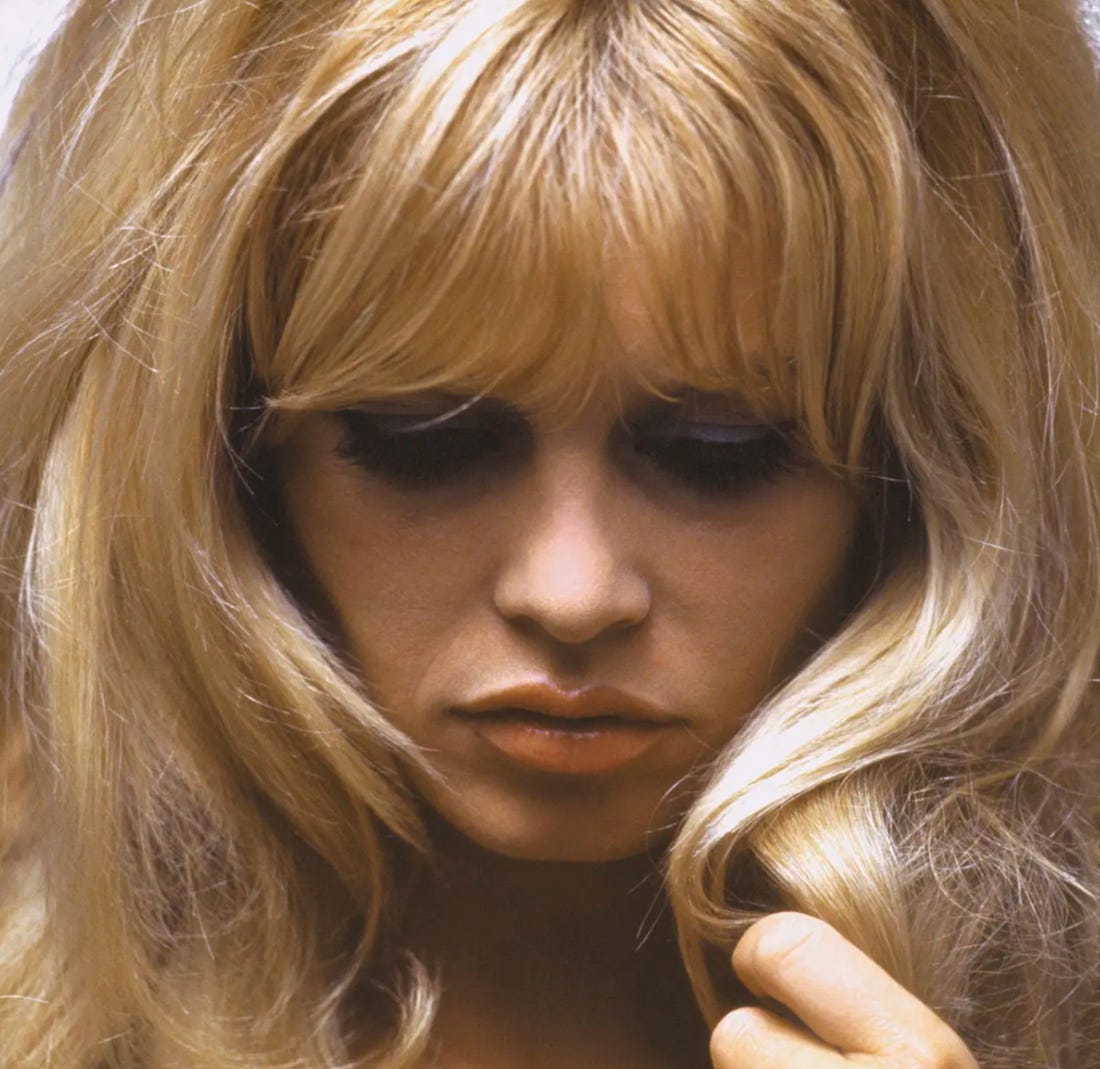
Letter from Juan-les-PinsDear Wags, The Sex Bomb, like the one made by smashing atoms, is a product of the twentieth century. No permutation of desire is new, but its transmutation into a global marketing hammer arrived only a moment ago, and it is already splintering alongside mass media. We have endlessly repackaged sex and turned it into science, art, philosophy, and, most of all, a justification. Yet the more we yammer on about it, the unsexier it becomes. Nearly seventy years ago, we gave desire a pouty mouth, teased its flaxen hair, slipped it into a bikini (named for that irradiated atoll), and called it Brigitte Bardot. Bardot, who died on December 28 at the age of 91, was a natural brunette. Her moment of fission came in 1956, when she discovered peroxide and starred in And God Created Woman, which also fixed her persona. “She is not an actress, she is Brigitte Bardot,” declared her first husband, Roger Vadim, the director of that film and an architect of her legend. The combination momentarily shook French cinema loose from the arthouse and turned Bardot into a phenomenon. Through B.B., the world dropped postwar austerity for topless hedonism. Vadim was correct. Bardot was less an actress than a durable distillation of commercialized lust symbols: the pouty mouth, the tousled hair, the kitten eyes, the dressed-only-in-a-man’s-shirt Esperanto for “up for it.” The look was so endlessly imitated — by the Beatles’ first round of wives, by Vadim’s next two (Annette Stroyberg and Jane Fonda), by Playboy bunnies and Pan Am air hostesses, by Raquel Welch, Claudia Schiffer, Amy Winehouse, teen-pop starlets, influencers, MAGA dolly birds, and generations of creative directors — that it can be hard to remember there was an originator with a villa in Saint-Tropez. For the English-speaking world, Bardot became shorthand for French sophistication: a jet-age package tour to unencumbered heterosexual adventure after air raids, ration books, and Protestant prudery. By the time she retired in 1973, hardly a nymphet at 39, the romp was over, along with much of what had passed for lighthearted escapism in the 1960s. In retirement, she became associated with the far right. Bardot aligned herself with France’s National Front (now National Rally). Her fourth and final husband, Bernard d’Ormale, was an adviser to party leader Jean-Marie Le Pen, which deepened her identification with its worldview. Over the years, she was prosecuted repeatedly for inciting racial hatred after broadsides against Muslims, immigrants, gay people, and what she called a “degenerate” modern France that tolerated them. In 2019, she described the inhabitants of Réunion as “savages.” And in one of her final interviews, she dismissed #MeToo and defended Gérard Depardieu with a Gallic shrug: “Feminism isn’t my thing. I like guys.” Continue reading this post for free in the Substack app
|