

Ticker Reports for December 16th
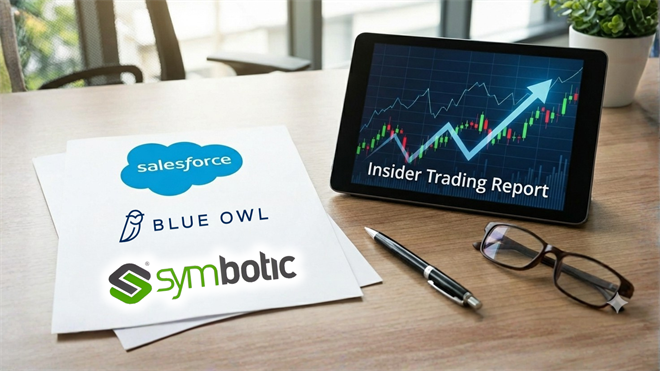
3 Insider Moves You Shouldn't Ignore Heading Into 2026
Insider trades are often some of the most revealing signals in the market—and three recent moves are sending sharply different messages. At Salesforce (NYSE: CRM), a board member is doubling down after a rough year. Symbotic (NASDAQ: SYM) just saw its first major insider sale after a dramatic run-up. And Blue Owl Capital (NYSE: OWL) is attracting widespread insider buying despite poor recent performance. Together, these trades offer a window into what insiders believe lies ahead.
$25 Million Salesforce Board Member Buy Reflects Long-Term Confidence
Shareholders in tech giant Salesforce clearly just received a bullish signal from Mason G. Morfit, who sits on the company's Board of Directors.
On Dec. 5, Morfit purchased approximately $25 million worth of the company’s shares for investment management firm ValueAct Capital, where he serves as co-CEO and Chief Investment Officer.
Because ValueAct manages outside capital, the purchase likely reflects high-conviction analysis and underscores the seriousness of this bullish signal.
Salesforce has come under considerable pressure in 2025, down around 21%. However, the company’s latest earnings report, released on Dec. 3, has moved sentiment in the right direction with shares up around 10% through Dec. 12.
Despite a meager recovery recently, the stock remains down more than 40% from its all-time high. Insider buying, combined with the firm’s AI momentum, provides hope that the rebound can continue.
The company’s agentic artificial intelligence (AI) tool Agentforce has seen rapid adoption. Annual recurring revenue for the product grew 330% last quarter versus a year ago, supporting its target of over 10% annual revenue growth through fiscal 2030. While some investors remain skeptical of this growth trajectory, Morfit’s sizable purchase signals institutional confidence in Salesforce’s long-term AI strategy.
SoftBank Trims Symbotic Stake for the First Time After Massive 2025 Rally
On the other side of the equation, robotics company Symbotic just saw a significant insider sale from one of its biggest backers.
Major shareholder SoftBank Group (OTCMKTS: SOBKY), a large Japanese investment company known for taking stakes in tech companies, sold more than $186 million worth of Symbotic shares on Dec. 8.
Symbotic makes robotic systems used to optimize warehouses, with Walmart (NASDAQ: WMT) being its primary customer. The company’s stock has surged approximately 159% year-to-date (YTD), making SoftBank’s timing on the sale strategically sound.
According to its last 13F filing, Symbotic is one of SoftBank's largest positions. Since taking a position in 2022, SoftBank has only increased the number of Symbotic shares it owns. This coudl be seen as a bearish indicator for the stock.
With this recent sale, SoftBank reduced its position in Symbotic by around 9% from 39.8 million shares to 36.3 million shares. SoftBank continues to hold a large position in Symbotic, but it is also not unrealistic to think that this could be the first in a series of reductions in its Symbotic stake. Investors should monitor further moves like this going forward.
4 Blue Owl Executives Buy Shares Despite Weak Performance
Blue Owl Capital, a firm focused on private credit and direct lending, has faced significant pressure in 2025, posting a negative 30% total return YTD—but its top executives are sending a different message.
In December, four senior insiders, including both co-CEOs, the CFO, and Credit platform head Craig Packer. In total, these insiders purchased $5.9 million in OWL shares. The fact that many top players at the company are buying shares is a solid bullish indicator for Blue Owl stock.
Blue Owl made headlines back in October after it entered a joint venture with Meta Platforms (NASDAQ: META). Blue Owl will provide funds to finance the development of Meta’s Hyperion data center and will own an 80% interest in the facility. This could become a meaningful revenue stream and help justify long-term optimism.
Follow the Smart Money
Insider trades often reveal priorities and pressure points that don’t always show up in earnings reports. December’s moves suggest that leadership at Salesforce and Blue Owl sees untapped upside, while SoftBank’s partial exit from Symbotic may reflect a shift in risk tolerance.
As 2026 approaches, these insider actions offer an early read on which strategies insiders believe are built to last—and which may be due for recalibration.


3 AI Names With Big Buybacks: GEV, PSTG, and LSCC Signal Confidence
Artificial intelligence (AI) stocks have taken a hit lately—but not all are moving in lockstep. Some names are rallying, others are falling, and a few are holding steady while sending strong signals through new buyback authorizations. Below are three AI-related stocks with differing trajectories but one thing in common: expanded buyback programs.
Let’s break down what their recent moves mean for investors.
GEV Boosts Mid-Term Outlook and Buybacks
First up is one of the world’s biggest names when it comes to powering AI, GE Vernova (NYSE: GEV). Since Nov. 21, shares have ballooned by approximately 21%. This comes despite shares being down nearly 7% from Dec. 10 to Dec. 12, as Broadcom (NASDAQ: AVGO) and Oracle’s (NYSE: ORCL) earnings prompted an AI sell-off.
The stock’s recent gain is primarily due to its Dec. 9 press release, which caused shares to rise by nearly 16% the next day. The company significantly raised its outlook through 2028 and now expects to generate $52 billion in revenue that year, up from prior estimates of $45 billion.
The company also raised its buyback authorization to $10 billion. This is equal to a significant 5.5% of the stock’s $177 billion market capitalization.
This is a clear signal of the company’s confidence in its future and the trajectory of its stock price.
Even with shares up more than 100% in 2025, GEV is indicating that there is still value in its stock. Analysts seem to agree. The consensus price target of analysts tracked by MarketBeat is around $654, which implies 3% downside in shares. However, among forecasts updated after the company’s long-term outlook increase, the average target is $802. This figure implies 19% upside.
PSTG Announces Record Buyback Authorization After Shares Tank
Pure Storage (NYSE: PSTG) got thwacked after its latest earnings release on Dec. 2. Shares dropped more than 27% the next day. This came even though the company exceeded expectations on sales and met expectations on adjusted earnings per share (EPS). However, the company’s plans to significantly increase research and development spending weighed on shares.
Notably, on Dec. 10, Pure Storage added $400 million to its buyback chest, increasing its total buyback capacity to $420 million.
That is equal to around 1.9% of the stock’s approximately $22.4 billion market capitalization, Pure Storage’s largest buyback announcement ever. Given the timing of this announcement, Pure Storage very likely sees value in its share price after the recent decline.
Analyst price targets back this notion. The consensus price target of around $95 implies 34% upside in shares.
Among analysts who updated their forecasts after the company’s earnings, the average target is slightly lower at around $92.50. However, even the average update still indicates significant upside potential of 30%.
LSCC: $250 Million Buyback Amid Increasing AI Adoption
Last up is a smaller but appreciating name, Lattice Semiconductor (NASDAQ: LSCC). Lattice reported earnings on Nov. 3 that slightly exceeded sales estimates and matched EPS expectations. However, the stock fell over 13% on Nov. 4.
Since then, Lattice shares have rebounded mightily, gaining over 19% and rising more than 33% year-to-date in 2025.
Supporting this recovery was a $250 million buyback authorization announced on Dec. 5—representing about 2.4% of its $10.3 billion market cap.
Lattice is positioning itself as a growing player in AI, forecasting that AI applications will account for 25% of its total demand in 2026, up from less than 20% in 2025. This rising relevance in the AI ecosystem adds to the case for the buyback.
Analysts currently see a limited amount of upside potential in Lattice shares. The consensus price target near $77.50 implies only 3% upside. However, the average of targets updated after the company’s earnings release comes in at nearly $80. This slightly more bullish figure implies around 6% upside.
Take Note of PSTG’s Big Buyback Boost
GEV, PSTG, and LSCC are sending confident signals to investors through their buyback authorizations. Among this group, the timing and size of Pure Storage’s announcement stand out. The company likely believes its recent sell-off is unjustified and is seeking to capitalize on its depressed share price.

Elon's Terrifying Warning Forces Trump To Take Action
Elon's Terrifying Warning Forces Trump To Take Action

3 Healthcare Giants Just Raised Dividends—Here's Who Pays the Most
Major players in healthcare are increasing their commitments to return capital to shareholders, resulting in significantly higher dividends. Recent dividend announcements from major companies in the sector highlight evolving capital return strategies. Analyst forecasts also shed light on where these stocks may be headed next.
SYK Lifts Dividend as Analysts Eye Substantial Upside
First up is Stryker (NYSE: SYK). With a market capitalization of around $135 billion, Stryker is one of the most valuable stocks in the healthcare equipment and supplies industry. Despite both revenue growth and margins holding steady, Stryker has not performed well in 2025, delivering a total return of approximately -1%. Still, the company beat estimates in its latest earnings and raised its full-year guidance.
On Dec. 11, Stryker rewarded shareholders with a 4.8% dividend increase. The company’s quarterly dividend will move up to 88 cents per share. This dividend is payable on Jan. 30, 2026, to shareholders of record as of the close of business on Dec. 31. Overall, the stock now has an indicated dividend yield of approximately 1%.
Wall Street analysts have a fairly bullish view on Stryker going forward. The MarketBeat consensus price target of just under $432 implies 22% upside in shares. Targets updated after the company’s latest earnings release on Oct. 30 are slightly less bullish, but still suggest solid upside potential. Those targets average out to approximately $425, indicating upside of 20%.
AMGN Raises Outlook, Dividend Yield Eclipses 3%
Amgen (NASDAQ: AMGN) is a massive player in the biotechnology and pharmaceutical space, with a market capitalization of around $171 billion. Overall, the firm is one of the world’s ten most valuable stocks in this industry. The stock has had a good year in 2025, delivering a total return of approximately 26%. The company’s latest earnings, released on Nov. 4, impressed investors. The company posted beats and raised its full-year guidance. Notably, 16 of the company’s drugs posted double-digit growth rates, showing that it is not reliant on a single product to drive growth. Its largest revenue driver, Prolia, also grew by 9%.
On Dec. 9, Amgen declared a quarterly dividend of $2.52, a solid 5.9% increase. This new dividend is payable on March 6, 2026, to stockholders of record as of the close of business on Feb. 13, 2026. The stock now holds a very strong indicated dividend yield of around 3.1%.
The MarketBeat consensus price target near $332 implies only around 5% upside in shares. However, price targets updated after the company’s latest earnings are more optimistic. They average to approximately $348, suggesting 10% upside potential.
LLY Provides 15% Dividend Increase with Shares Up Big in 2025
Last up is the undisputed king of pharmaceuticals, and healthcare for that matter, Eli Lilly and Company (NYSE: LLY). Its $920 billion market capitalization makes LLY by far the world’s most valuable stock in the healthcare sector. In second place is Johnson & Johnson (NYSE: JNJ). The firm’s market capitalization of $510 billion doesn’t hold a candle to Lilly. In 2025, Lilly has delivered an impressive total return of 34%. The company’s weight loss and diabetes drugs continue to see rabid demand, and it has more of these medicines in its pipeline. Last quarter, Lilly significantly beat analyst estimates on both sales and adjusted earnings per share (EPS).
On Dec. 9, Lilly declared a quarterly dividend of $1.73, marking a 15.3% increase over its previous payout. The new dividend is payable on March 10, 2026, to shareholders of record at the close of business on Feb. 13, 2026. Lilly’s indicated dividend yield now stands at nearly 0.6%.
The MarketBeat consensus price target on Lilly is near $1,109, suggesting that shares could rise an additional 8%. Targets updated after the company’s latest earnings report, released on Oct. 30, are more bullish. Their average is around $1,138, implying around 11% upside.
Among SYK, AMGN, and LLY, Amgen Leads on Income Potential
Based on their valuations, SYK, AMNG, and LLY all clearly hold important positions in the healthcare sector. In terms of providing investment income, Amgen stands out. It is one of the few U.S. large-cap healthcare stocks with a dividend yield above 3%.

The window is closing (and I have proof)
The window is closing (and I have proof)

MarketBeat Media, LLC dba TickerReport
345 N Reid Place, Suite 620, Sioux Falls, SD 57103.