

Ticker Reports for June 17th

Lululemon, UNH, Enphase: Bad News, Good Opportunity?
Downgrades are detrimental to a stock’s price momentum and often lead to sustained downtrends. However, sometimes good stocks are plagued by bad news that ultimately leads to a buying opportunity. Today, we’re examining three such stocks: good companies suffering from bad news, whose analyst trends are driving their stock prices lower, setting them up for potential buying opportunities that may be confirmed this year.
Lululemon Moves Lower on Margin Compression
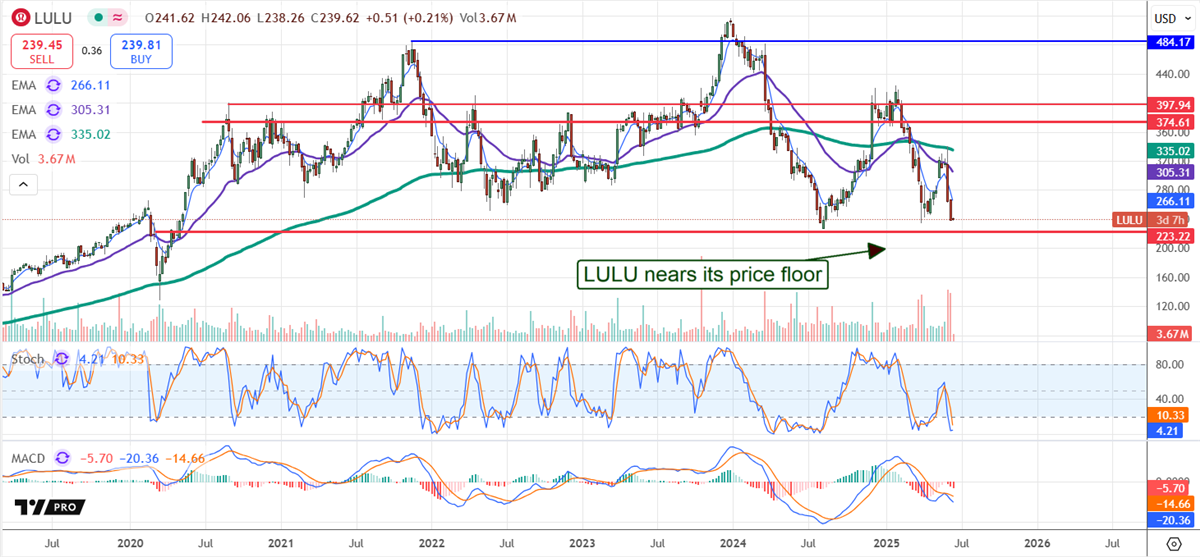
Lululemon (NASDAQ: LULU) has suffered from numerous headwinds, including sluggish growth, but it has overcome them all. The story in 2025 is one of margin compression despite growth and top-line outperformance, which is leading to a sustained trend of price target reductions.
Lululemon is the top-ranked stock on MarketBeat’s list of Most Downgraded Stocks in mid-June, but take it with a grain of salt. The negative activity is primarily reflected in price target reductions, which leave it rated as a Moderate Buy with firm coverage and a potential 40% upside at the consensus. Investors can buy this stock while it is trading near long-term lows, aligning with the bottom of a trading range.
Reasons to buy Lululemon include its positive growth trajectory and robust cash flow. The company experienced margin compression but still achieved an 18% operating margin, which is sufficient to sustain its healthy balance sheet and support business investment. Its valuation stands at 16x the current year's earnings and just 10x the projected earnings for 2030.
UnitedHealth: A Perfect Storm of Bad News
UnitedHealth’s (NYSE: UNH) stock price plummeted in April and May due to a perfect storm of bad news, including regulatory, legal, and margin issues. The news led analysts to drastically reduce their price targets, shaving thousands of basis points off the consensus target in weeks, opening up a deep value opportunity for dividend investors.
Although there are risks, UnitedHealth’s cash flow is robust and can sustain its capital return, including a nearly 3% dividend yield. Key takeaways from the analysts’ data are that the price target has been lowered. Still, coverage is rising, and sentiment remains firm at a Moderate Buy, with a potential 40% upside according to the consensus.
Another factor for investors to consider is the institutional activity. The institutions own approximately 87% of the stock and acquired it on balance in Q2. Not only was buying activity solid at roughly $12 billion, flat compared to the prior quarter, but selling volume declined, resulting in an above-average build for the quarter. Assuming this trend continues, UNH shares are unlikely to fall significantly further.

Enphase: Out of Phase With Government Spending
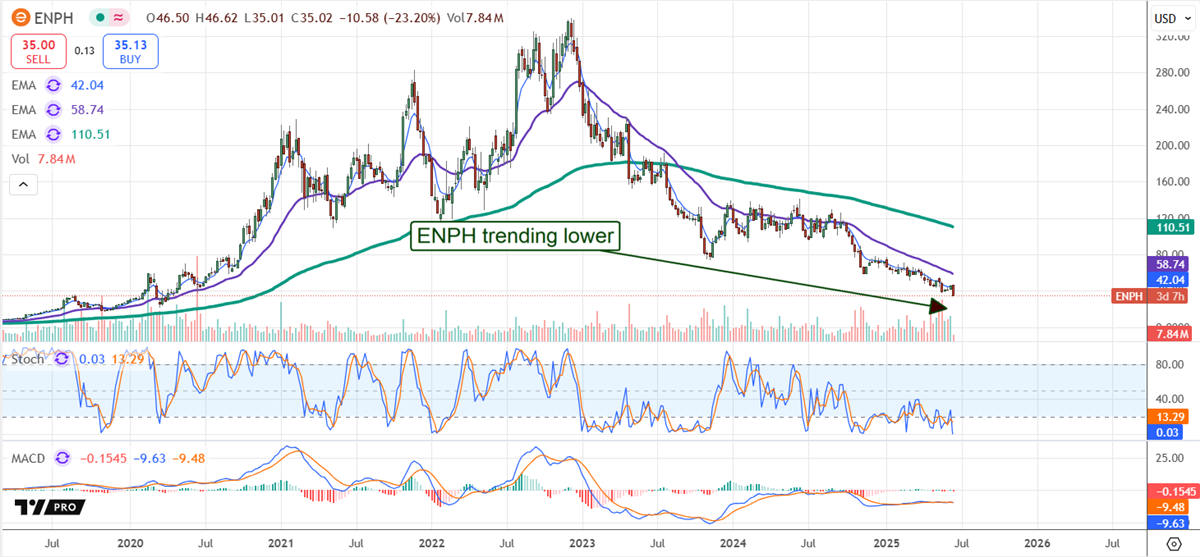
Enphase's (NASDAQ: ENPH) biggest challenge in 2025 is the impact of the Trump administration on subsidies for alternative energy. Even so, the effect is significant and undercuts the outlook for revenue and earnings. The latest blow is the budget bill, which is moving through Congress with cuts to subsidies intact.
The impact on the stock price is another significant plunge that aligns it with the low end of the analysts' target range, potentially heading lower. The question is whether the bill is passed with the cuts intact and whether the company can sustain operations with them in place. The stock price is likely to maintain its downtrend until they are answered, which may not be until later in the year or 2026.
Institutional interest and short selling are two factors that suggest the downtrend will persist. The institutions own more than 70% of the stock, representing a powerful market force, and they sold on balance in Q1 and Q2. That trend is not expected to end in Q3 or Q4 unless there is a change in Trump’s tax bill. Short sellers' interest was high at roughly 20% at the end of May and is unlikely to decline significantly until there is a hint of good news.
REVEALED FREE: Our top 3 stocks to own in 2025 and beyond
REVEALED FREE: Our top 3 stocks to own in 2025 and beyond

3 Tech Stocks You Can't Miss in This Market Cycle
There comes a point in each stock market cycle when most investors begin to focus on a specific type of company to target. In the past, these companies might have been the tried-and-tested commodities of everyday life, but today’s market is much more focused on names that offer some of this stability with an additional growth factor, which is where the technology sector comes into play.
Technology has also evolved since those times, making today’s companies the sort of everyday commodities that can provide portfolios with the stability and upside any investor would want to see during volatile times, such as the current S&P 500. With geopolitical risks escalating in the Middle East and ongoing trade tariff negotiations in the United States, it appears that only one business model remains safe from all this today.
These business models are focused on software that is not only part of everyday life but also carries the attractive factor of subscription revenues. That is why names like Reddit Inc. (NYSE: RDDT), Spotify Technology (NYSE: SPOT), and Roku Inc. (NASDAQ: ROKU) come to give investors the sort of promise that they have been looking for during these highly volatile environments.
An Undeniable Discount in Reddit Stock
Now that shares of Reddit have traded down to only 51% of their 52-week highs, it is obvious that the stock is in a deep discount. However, that price action alone is no reason to start buying blindly, as there must be other factors (fundamentally focused) to drive the stock back to its former glory highs.
The business model is one factor. Although it doesn’t quite fit the subscription model, it deserves mention because it supports one of the hottest trends in technology today: the development of artificial intelligence specifically tailored to large language models (LLMs).
Much bigger companies like Alphabet Inc. (NASDAQ: GOOGL) rely on Reddit’s natural language environment to provide them with ways to train their chat agents to serve incoming users. Those who wonder why a platform like Twitter (now X) can’t do the same should note that Reddit strictly prohibits any language that is geared toward selling or advertising.
Therefore, this is as natural and as “human” as it gets, creating massive value for these larger players to pay for access to Reddit’s data. Seeing double and even triple-digit growth rates in user bases and time spent on the platform (according to recent quarterly data), investors can see how this might become a massive profit center for the company.
Alan Gould, an analyst at Loop Capital, is well aware of this. As of mid-June 2025, he had reiterated a Buy rating on Reddit stock, assigning a $200 per share price target to call for 69.5% upside potential from its current trading price.
The More Stable Model Goes to Spotify
There is a reason Spotify now trades near its 52-week high, unlike the other names on this list. This is the purest social play there is, considering that no user wants to be caught listening to advertisements among friends during a hangout or long car drive. That peer pressure is the beauty behind Spotify’s model.
This is why the stock has managed to retain its high prices, despite the significant declines seen across the sector and the broader S&P 500. In terms of upside, some institutional buyers believe there is still a chance to reach a new 52-week high down the line.
Allocators from UBS Asset Management decided to increase their holdings in Spotify stock by 39.9% as of mid-May 2025, bringing their entire position to $648.4 million today and also signaling confidence that an even brighter future might await the stock in the coming months.
For a Premium Name, Choose Roku
There is a reason Roku trades at a price-to-book (P/B) ratio of up to 4.4x today compared to other streaming and television stocks. This valuation demands a significant premium compared to its peers, which are valued at just 1.5 times on average.
While some might call this overextended and expensive, seasoned investors and traders will remind these critics that the market is always willing to pay up for the companies it believes will outperform peers and the broader market. The reasoning behind this belief can be attributed to the same themes that underpin the other names on this list.
Roku is now a commoditized service that is also young enough to continue delivering explosive user growth, which is reflected in its financial profile. Additionally, the subscription revenue model enables management and Wall Street analysts to predict future numbers and valuations with greater accuracy and confidence.
This is why JMP Securities analyst Matthew Condon decided to maintain his Market Outperform rating on Roku stock as of early June 2025, also placing a valuation target of up to $95 per share on the company. Relative to today’s prices, which are only 71% of the 52-week highs, this view offers investors a rally of as much as 30% to align their portfolios with some explosive moves.

BREAKING: Trump vs. Elon Feud Threatens Your Retirement – Protect Yourself NOW
BREAKING: Trump vs. Elon Feud Threatens Your Retirement – Protect Yourself NOW

3 Stocks With Major Buyback Power: AI & Auto in Focus
Buyback capacity is moving up in a very big way for three stocks. Two tech stocks hoping to leverage and profit from AI are indicating that management has significant confidence in generating future returns. Additionally, an automobile components company can now buy back nearly a third of its shares.
MongoDB Expands Share Buyback Program to $1 Billion
On June 4, MongoDB (NASDAQ: MDB) reported earnings that ended its streak of disappointing results. The company also announced a big increase to its share buyback program. MongoDB raised its share repurchase authorization by $800 million.
Now, its total buyback capacity is $1 billion. This is a substantial buyback capacity, equal to approximately 5.9% of the company’s market cap as of the June 13 close.
MongoDB’s stock has dropped dramatically over the past 16 months or so. The stock reached a share price of around $500 in February 2024, but now trades in the low $200 range. MongoDB has never actually spent on stock buybacks before, and the timing of the authorization suggests the company sees value in its stock near current levels.
This was a welcome surprise, especially when paired with the company’s Q1 financials that beat on sales and adjusted earnings per share (EPS). Shares rose approximately 13% in the day after the results. This comes after the company’s March report, when shares saw a post-earnings drop of 27%.
The company issued its full fiscal year outlook that quarter, and analysts considered it disappointing. It has been waiting to gain traction in AI application-building use cases, but progress has been slow. Still, the company’s subscription growth last quarter was strong at 22%.
Autoliv Launches $2.5 Billion Share Repurchase Program
Next up is Autoliv (NYSE: ALV). The company just announced a massive share repurchase program. The company’s $2.5 billion authorization is equal to around 30% of its market capitalization as of the June 13 close. The program will last through the end of 2029, or approximately 18 quarters. Autoliv would need to significantly accelerate its buyback pace to utilize this full capacity over that period.
Since the company began repurchasing stock back in 2022, it has averaged buyback spending of around $82 million per quarter. To use the full $2.5 billion over 18 quarters, that number would need to ramp up to around $139 million per quarter, an increase of nearly 70%.
Autoliv also raised its dividend by 21%. Its next $0.85 per share dividend will be payable on Sept. 23 to shareholders of record on Sept. 5. This quarterly figure implies an annual dividend payout of $3.40, giving the stock an indicated dividend yield of approximately 3.2%.
DocuSign Adds $1 Billion to Share Buyback Authorization
DocuSign (NASDAQ: DOCU), a software firm implementing AI, also just announced a substantial addition to its buyback authorization.
The company’s additional share buyback authorization is worth $1 billion. This adds to the stock’s previous authorization, bringing its total buyback capacity to $1.4 billion. This total is equal to around 9.4% of the company’s market capitalization as of the June 13 close. DocuSign has really stepped up its buybacks recently, spending $700 million on repurchases over the last 12 months. From 2020 to 2023, its average annual spending was only around $300 million.
Shares have been moving on an upward trajectory, rising around 44% over the past 52 weeks. This strong performance comes even after the firm’s latest earnings, which caused shares to fall 19%. However, the company’s recent rise in buybacks indicates confidence in the generally improving outlook of its own business. Recent buyback activity and the sizeable new authorization suggest that the company thinks shares can keep rising.
DocuSign is in the process of releasing AI features for customers powered by its Iris AI engine. It plans to roll out AI contract agents later this year. This tool will analyze contracts in seconds, creating efficiencies over manual contract review.
These increases in share buyback capacity seem to indicate that management is confident in the direction of shares going forward. For Mongo, this may be more due to the huge drop in its share price. Management may think the stock is hitting a bottom near current levels.
For DocuSign, management may be bullish on its coming AI features and believes that markets are undervaluing its growth prospects. For Autoliv, the sheer size of the new authorization suggests a strong commitment to shareholder returns and confidence in long-term performance, especially following its recent dividend increase.

How Tim Found Tesla's Secret 69% "Dividend"
How Tim Found Tesla's Secret 69% "Dividend"

MarketBeat Media, LLC dba TickerReport
345 N Reid Place, Suite 620, Sioux Falls, SD 57103.