

Ticker Reports for March 7th

These 3 Iconic Brands Just Announced Bigger Dividend Payouts
To build a company that stands out, marketing experts all say one thing: "Branding is everything." Although creating an iconic brand is easier said than done, once achieved, it can have remarkable benefits for a business.
Firms can have pricing power because of their brand's prestige, even if their product isn't better than the competition. This is true because brands can make people feel associated with something important. Other businesses also often want to align themselves with companies that consumers respect. In many cases, creating a successful brand goes hand in hand with creating a long-standing successful business.
A benefit of long-term business success is that companies have more ability to return capital to their shareholders. Below is a look at three iconic brands doing just that.
Coca-Cola: Beverage King’s Dividend Yield Approaching the 3% Mark
Perhaps no company in the world exemplifies the power of branding better than Coca-Cola (NYSE: KO). Many studies over the years have had people blind taste-test Coca-Cola and Pepsi (NASDAQ: PEP).
According to the University of South Carolina, participants tend to prefer the taste of Pepsi over Coke in these tests. However, Coke remains the dominant soda brand in the United States, with approximately twice the market share of Pepsi. Many say this is because of Coke’s strong branding. They believe that the packaging makes people think Coke tastes better.
In 2024, Coke had an adjusted gross margin of 61%, while Pepsi’s was 55%. This suggests that Coke may have some pricing power over Pepsi. However, it is a little difficult to say for sure based on this metric. Pepsi also sells snacks, while Coke almost exclusively deals in beverages, introducing some complications in this assessment.
Now, Coke is rewarding shareholders with a 5.2% dividend increase. The next quarterly dividend is payable on Apr. 1 to shareholders of record as of Mar. 14. This is the firm’s 63rd consecutive annual dividend increase. Based on its Mar. 4 closing price, the company has a strong indicated dividend yield of 2.9%.
Home Depot: Dividend Payments Are Getting an Improvement
The iconic American home-improvement store Home Depot (NYSE: HD) is also raising dividends. Although Home Depot’s brand isn’t as globally recognized as Coke, the dominance of this brand in the United States is undeniable.
The company operates mostly in the United States, with 86% of its stores located in the 50 states or U.S. territories. The rest of its stores are in Canada and Mexico.
Home Depot’s U.S. dominance is highlighted by its market capitalization of around $380 billion, nearly three times larger than its nearest U.S. competitor, Lowe's Companies (NYSE: LOW).
Home Depot recently announced a significantly smaller dividend increase, but it is still worth talking about compared to Coke. Its dividend will rise by 2.2%, and it will now pay out an annual dividend of $9.20 per share.
The next quarterly dividend will be payable on Mar. 27 to shareholders of record at the close of business on Mar. 13. The company also has a strong indicated dividend yield of 2.4% as of the Mar. 4 close.
Ferrari: Addressing the Need for Speed and Higher Dividends
Going overseas, one of the world’s most iconic carmakers, Ferrari (NYSE: RACE), just announced a huge dividend increase. The company will increase its annual dividend by 22% to 2.99 euros per share.
This will apply to its shares traded on both the Euronext Milan (EMX) and the New York Stock Exchange (NYSE). Using a euro to U.S. dollar exchange rate of 1.08 USD to euros, this equates to $3.22 per share. Based on this, its dividend yield would be 0.7% on both the NYSE and EMX as of the Mar. 4 close.
If approved by shareholders, the single annual dividend will be payable on May 6 to shareholders of record on Apr. 23.
Ferrari's strong connection to Formula 1 racing helped shape its iconic brand. Its cars are famous for their combination of speed and maneuverability.
The Ferrari F1 racing team is the only one to have competed in every F1 season since the world championship began.
It may come as a surprise to some that, with a market capitalization of over $80 billion, the company is significantly more valuable than any of the Detroit Three U.S. carmaker stocks.

Jeff Brown's Urgent March 17th Alert
Elon's newest tech could pay you an extra $30,000 a year — while you sleep.
It's smaller than a quarter but designed to power a $9 trillion AI revolution.
And I've identified a little-known supplier Elon is depending on to make it all happen.
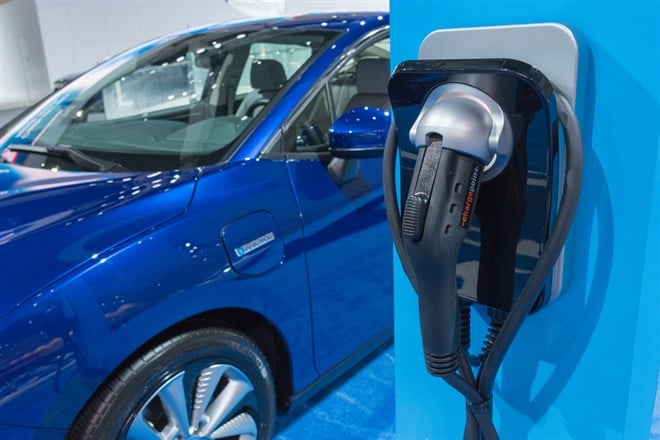
4 EV Stocks Facing Uncertainty—Which Ones Will Survive?
There were such high hopes for the electric vehicle market, which is the problem with the share prices of EV stocks today. The outlook for EVs was and is robust, but the growth was priced in at the very start. Since then, EV companies failed to capture the growth or profits forecasted without cutting deeply into shareholder value. Many EV OEMs have relied heavily on dilutive actions and share price manipulation to keep themselves afloat and investors interested.
The critical takeaway for investors is that many EV companies have advanced the technology and/or established infrastructure with some value; the question is if the respective companies can unlock it. If history can be used as a guide, there are more bankruptcies on the way, but maybe not for everyone. Nikola is the latest to file for Chapter 11 protection and wipe out its shareholders; others may soon follow suit.
Mullen Automotive Gains Traction, Incrementally
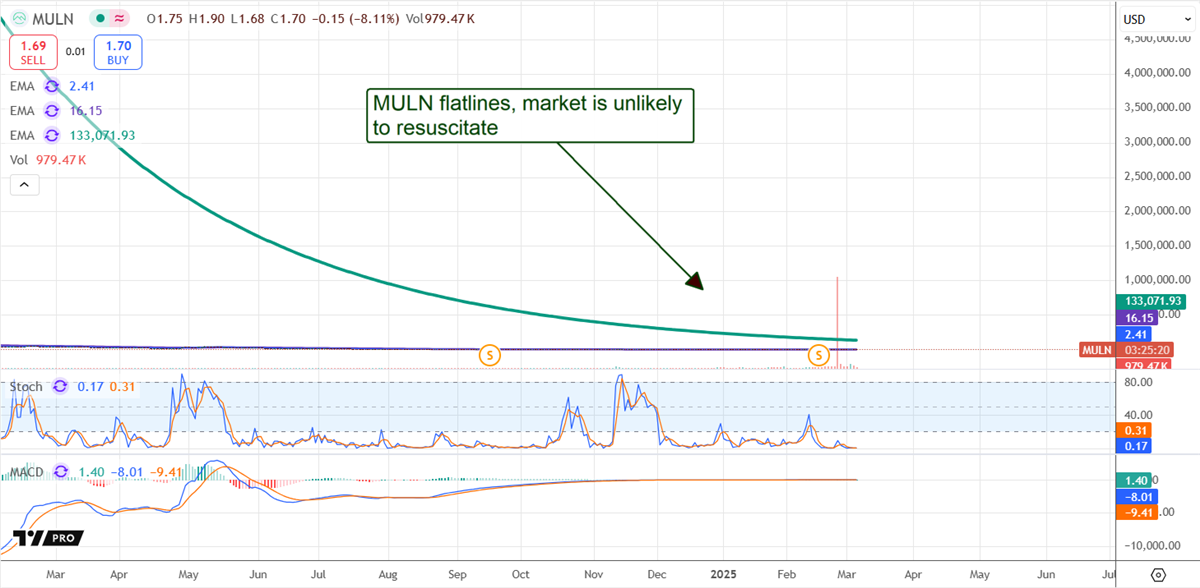
Mullen Automotive (NASDAQ: MULN) appears to be gaining business traction, but the gains are incremental and offset by looming factors, including share dilution, revenue quality, and bankruptcy risk.
Regardless of other factors influencing real shareholder value, Mullen has reverse split its stock five times in two years and may do it again to keep the price up.
The takeaway is that shareholders from 2022 are looking at holding worth fractions of pennies on the dollar, and later buyers are only marginally better positioned.
The latest news includes company-sponsored sales, not dilutive sales, but a significant amount to be floated on an already-laden market. Short interest in this stock remains high and will likely push it back to sub-$1 price points in 2025.
Workhorse Group Is Approved for Sale in Canada, So What?
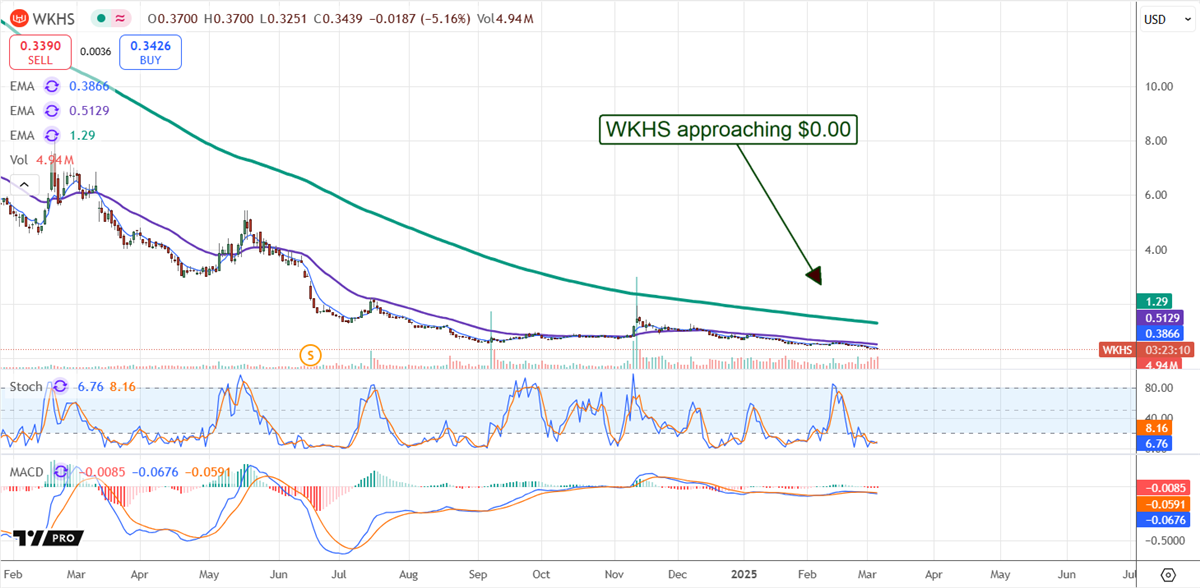
Workhorse Group (NASDAQ: WKHS) regained traction after its incredible business reorganization and refocusing. Now, its W750 and W56 electric vans are seeing improved demand, but new hurdles have arisen.
The latest news from the company is the approval of its vans for Canadian markets, a revenue stream impeded by Trump’s tariffs and geopolitical tension.
However, even with Canadian sales in the picture, the company is not expected to produce significant revenue for years, and investors face the dual headwinds of dwindling assets and rapidly rising share counts.
The company leaned hard into dilutive activity in 2024, lifting its share count by roughly 150% on average for Q4 and more than 100% for the year. The short interest in this stock is running near 20% in Q1.
Lucid Investors Have a Parachute, the PIF, But It Won’t Help Them
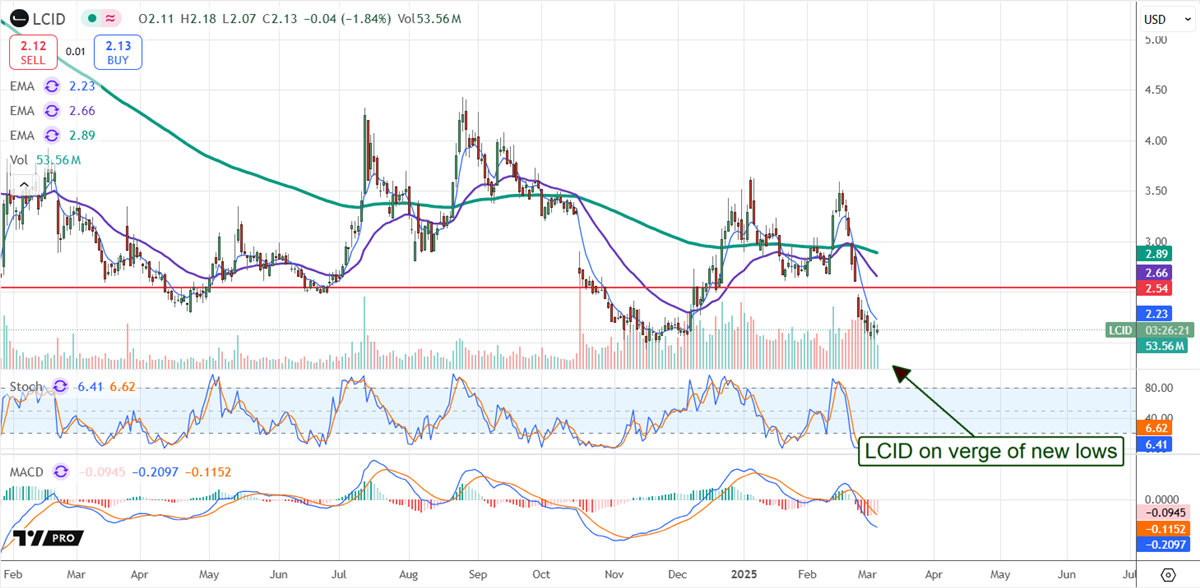
Lucid (NASDAQ: LCID) investors have a parachute with the PIF investing in the business, but it won’t help them. The likely outcome is dwindling capital reserves due to the expensive push to ramp production and launch new models, and the PIF will likely inject new capital.
Still, the increased ownership will squeeze average investors further out of the picture. The Saudi’s goal is to be a leader in EV use, production, and technology; all it may want is Lucid’s technology, which does not put investors in a good position.
Meanwhile, the company is undergoing a significant change as its CEO stepped down, taking an advisory position to the board, raising the question of what it will do next.
The short interest in LCID shares isn’t as high as MULN or LCID but sufficiently high to present a headwind for the market.
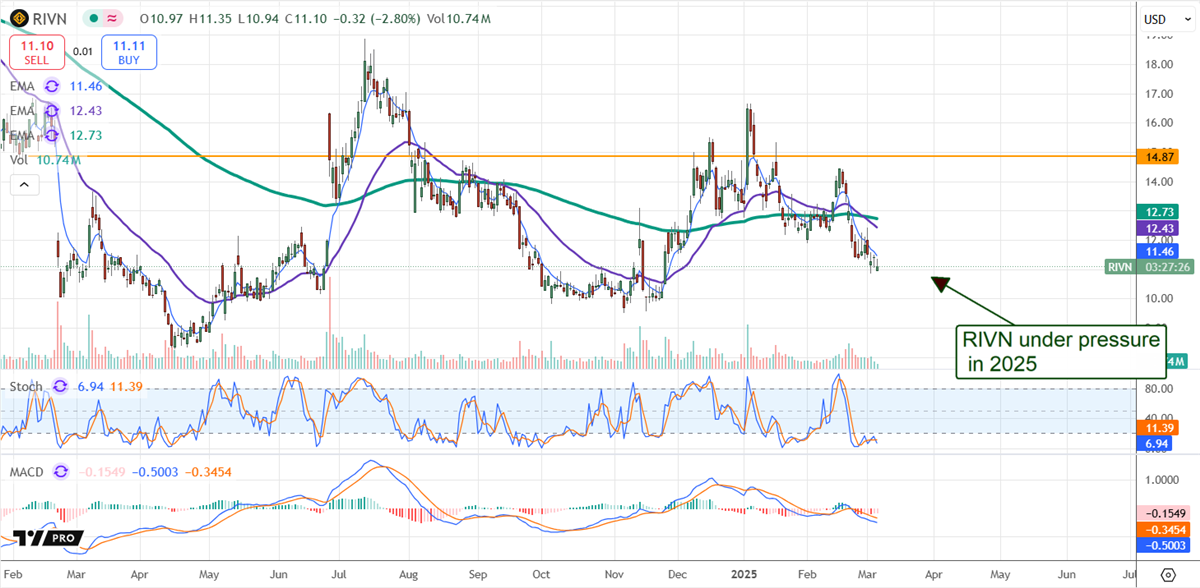
Rivian Is Best-Positioned But Still a Risky Investment
Rivian (NASDAQ: RIVN) is the best-positioned of North America’s EV OEM start-ups. It is ramping up production and inflecting to gross profitability in 2024.
The outlook for 2025 is for increased production, the launch of next-gen models, and improved profitability, although there are risks. The risks include the cost of ramping output and the balance sheet.
The company is capitalized now, but concerns remain that it may have to raise cash later this year or in early 2026. The analysts are optimistic, with coverage increasing, a firm Hold rating, and expectation for double-digit upside.
The bad news is that the price target revision trend is downward, with recent targets leading to the low-end range, and the short interest is high.

How this 3-cent coin is going to outperform Bitcoin
Chris Rowe – the man who recommended Amazon in 1998… Bitcoin and Ethereum in 2017…
And has spotted 44 different coins that have returned over 100%...
But today, Chris is now making the biggest crypto call of his ENTIRE career…
These 3 Big Banks Are Set to Gain as Consumers Stash More Cash
While the recent volatility breakouts in the S&P 500 have scared some investors out of the consumer discretionary space, as cyclical stocks tend to underperform during times of uncertainty, a few positive developments have emerged. Today, macroeconomic data in the United States economy will pay dividends for investors who are willing to look where most won’t.
Consumers worried about the stability of their personal finances have slowed down their spending, as seen in the first decline in consumer spending since 2021 for February 2025’s report. The lack of spending also drove the personal savings rate higher, leaving more cash on the sidelines, likely looking for investment opportunities.
This is where investors might look to bonds or dividend stocks to anticipate the demand for this capital to be reinvested into the market. However, not everyone looks at money – or the market – in this way, which is why most of the new savings will end up sitting in banks, and that’s why earnings per share (EPS) could rise for commercial names in the financial sector like Bank of America Co. (NYSE: BAC), Citigroup Inc. (NYSE: C), and also Wells Fargo & Co. (NYSE: WFC).
Understanding the Consumer’s Mind Today Can Pay Off
Now that the average consumer in the United States is experiencing the feeling of having more cash on hand due to the recent spike in the savings rate, a couple of things will happen with that money, and that’s where banking stocks in today’s list come into play.
Since most consumers are falling behind on credit payments, as seen through rising delinquencies on cards and other loans, this money will either be used to repay some of these debts or simply be left to sit idly in the bank. This dynamic has always been true, and that is why these banks might see better financial results in the near future.
When a bank has idle deposits on its balance sheet, this capital is typically used to collateralize new products and generate net interest income (NII). NII makes up for most of the momentum behind a bank’s earnings per share (EPS), which is also why investors should be aware of the upside inherent in these commercial banks.
Earnings Per Share Forecasts: All Point to Upside
For Bank of America, for example, Wall Street analysts today forecast up to $0.96 in EPS for the fourth quarter of 2025, a significant boost from today’s net earnings of $0.82 per share.
Considering that EPS typically drives stock price performance, investors can see how this will cause a potential new run in his stock coming up.
This also speaks for the fate of these new savings headed to the banks, as analysts already recognize that the bullish drivers are present enough to deliver investors the upside they are looking for in the sector.
The story rhymes for these other two commercial banks.
Analysts see Citigroup delivering up to $1.85 in EPS for the fourth quarter in 2025 as well, which would mean a net growth rate of up to 38% from today’s reported $1.34 in EPS.
Then, for Wells Fargo, these analysts forecast EPS of $1.60 for the fourth quarter of 2025, a significant boost of 12% from today’s net $1.43 in EPS.
Now that investors know what Wall Street expectations are, it’s time to consider where the upside potential lies.
The Market’s Take on These Banks
When it comes to sentiment, price action is typically the first indicator investors should consider when figuring out what the market is thinking about a specific stock or group of stocks.
Looking at these three banks and how they all trade at or near 90% of their 52-week highs, it becomes evident there is some optimism.
This optimism can be founded and justified on the EPS forecasts already covered and the broader theme of rising deposits from personal savings rates. Just how optimistic can investors be, though? Well, price targets might be helpful in this case.
Bank of America stock’s valuation lands at $56 per share according to Morgan Stanley analysts, who, as of January 2025, decided to call for up to 32% upside from where the stock trades today. With Citigroup, the story rhymes as these same analysts have decided to reiterate their Overweight targets on the bank while also keeping a $109 valuation on it for a 50.8% upside.
Barclays analysts also decided to keep an Overweight rating on Wells Fargo stock, this time valuing it at a high of $92 per share to call for as much as 26% upside from where it trades today. Now, investors can see how the fundamentals align with the themes in these savings rates and banking deposits.

MarketBeat Media, LLC dba TickerReport
345 N Reid Place, Suite 620, Sioux Falls, SD 57103.